
2026 Central Plains Dairy Expo Speakers
Discover a wide range of educational sessions designed to inform and inspire dairy professionals. From quick 30-minute expo floor presentations (Ed Shed) to one-hour breakouts and Spanish-language sessions, industry experts will share practical insights, innovative ideas, and solutions you can use right away. Find sessions that fit your schedule and make the most of your time at the 2026 Central Plains Dairy Expo.
Breakout Sessions
Dry Off: The Next Lactation Starts Here
Andre Rigo
Head of Global Technical Services | AHV USA
This session will explore why dry-off is one of the most critical – and often underestimated – moments in a cow’s production cycle. As today’s high-producing cows enter dry-off with more milk than ever, the risk of udder pressure, leakage, mastitis and stress increases – directly impacting health, welfare and performance in the next lactation. This session highlights how a smarter, biology-aligned approach to dry-off can set up cows for success. Learn how StopLac provides a modern, non-antibiotic solution that safely reduces milk production before dry-off, improves cow comfort, lowers mastitis risk and supports stronger intake, health and milk yield after calving – turning dry-off from a routine task into a true profit opportunity.
With more than 20 years of experience in the dairy and beef industries, Andre Rigo has worked as a field veterinarian and consultant, leading multidisciplinary projects and teams across multiple countries. Throughout his career, Rigo has served as a key interface among academia, research and development, and commercial teams – translating science into practical solutions, fostering knowledge transfer and developing new talent. As head of Global Technical Services, Rigo leads and continuously elevates AHV’s technical service organization worldwide. In this role, he sets the global technical strategy, empowers regional teams and ensures consistent delivery of high-value technical support that enhances customer experience for producers and industry professionals across all markets.
Moisture, Mycotoxins and Milk: What This Means for Your Herd
Max Hawkins
Global Technical Support | Alltech
Max Hawkins will discuss weather and disease in the 2025 crop and how it compares to previous years. He will explain how the wet conditions and warmer temperatures we experienced impacted plant health and why continued monitoring and management are critical for your operation. Also, he will discuss what we have seen so far and what’s on the radar for mycotoxins. Plus, he’ll share what you can do to defend against the damaging effects of challenged feedstuffs.
Max Hawkins works with the Alltech Technology Group, providing risk assessment and technical support in the mycotoxin area at all levels on a global basis. He brings years of experience in mycotoxin management, livestock production, nutrition, breeding and genetics, covering all livestock species. His past employers include Western Illinois University, University of Tennessee, Morehead State University, California Polytechnic State University, National Swine Registry, Continental Grain Company, Hubbard Feeds and Micron Bio-Systems. Hawkins works with risk assessment of feedstuffs and feeds, reducing mycotoxin risk throughout the growing season, harvest, storage and feed out. He places emphasis on understanding the livestock signals associated with a mycotoxin risk from the production-impacting, health-threatening risks to the economic losses from lower risk levels of mycotoxins. In addition to his duties with the Alltech Technology Group, he provides support to the Alltech Feed Division and evaluates mycotoxin risk for several integrated livestock companies.
High Replacement Prices, Higher Standards: Calf Management and Nutrition Strategies for Lifetime Returns
Lucas Mitchell
Technical Services Manager | Arm & Hammer Animal Nutrition
Replacements are the future of every dairy operation and they have never been more valuable. With prices elevated, settling for “good enough” leaves value on the table. In this session, Lucas Mitchell will share practical calf management tactics and research-proven nutrition strategies to mitigate stress and disease, optimize growth and raise the bar on replacement quality so today’s calves become tomorrow’s high-return heifers.
Lucas Mitchell is a dairy technical services manager for Arm & Hammer Animal Nutrition, where he leverages more than five years of applied dairy technical service and training experience. He partners with producers to improve youngstock nutrition and management, focusing on practical solutions for real-world challenges. He combines academic expertise – a bachelor’s degree in food science from Purdue University and a PhD in animal science from Penn State University – with hands-on experience rooted in his upbringing around dairy.

Start Strong and Stay Healthy with Injectable Trace Minerals in the Transition Period
Craig Louder
Senior Technical Consultant | Axiota Animal Health
The transition period remains the final frontier of dairy cow management. One of the overlooked contributors to transition period issues is the role of trace minerals. Parturition can decrease trace mineral levels by 30% and recovery can stretch out past six weeks through oral supplementation. This presentation will explore the impact that trace minerals have on fresh cow health and how strategic supplementation can help settle the final frontier.
Craig Louder graduated from Washington State University College of Veterinary Medicine in 2012. He joined High Desert Veterinary Services in Jerome, Idaho, where he practiced for nine years, becoming a partner in 2017. In 2018, he began consulting part time for MULTIMIN USA and transitioned to a full-time role as a technical services veterinarian with Axiota Animal Health in September 2021.
Commodity Price Risk Management – Protect your Bottom Line
Mark Newman
Account Executive, Dairy Team | Commodity & Ingredient Hedging
Dairy margins and profitability will continue to be volatile in the future. We’ll highlight some of the more important data and reports to follow, the risk management tools at your disposal and the different methodologies and strategies to consider to actively manage your dairy’s commodity price risks and profit margins.
Mark Newman has been an account executive on CIH’s dairy desk since 2019. He helps dairy producers across the country manage their risk, identify opportunities and develop comprehensive margin management strategies in this volatile economic climate. Newman attended the University of Iowa where he graduated with a bachelor’s degree in economics and master’s degree in finance. He also holds a series 3 license (National Commodities Futures Examination).
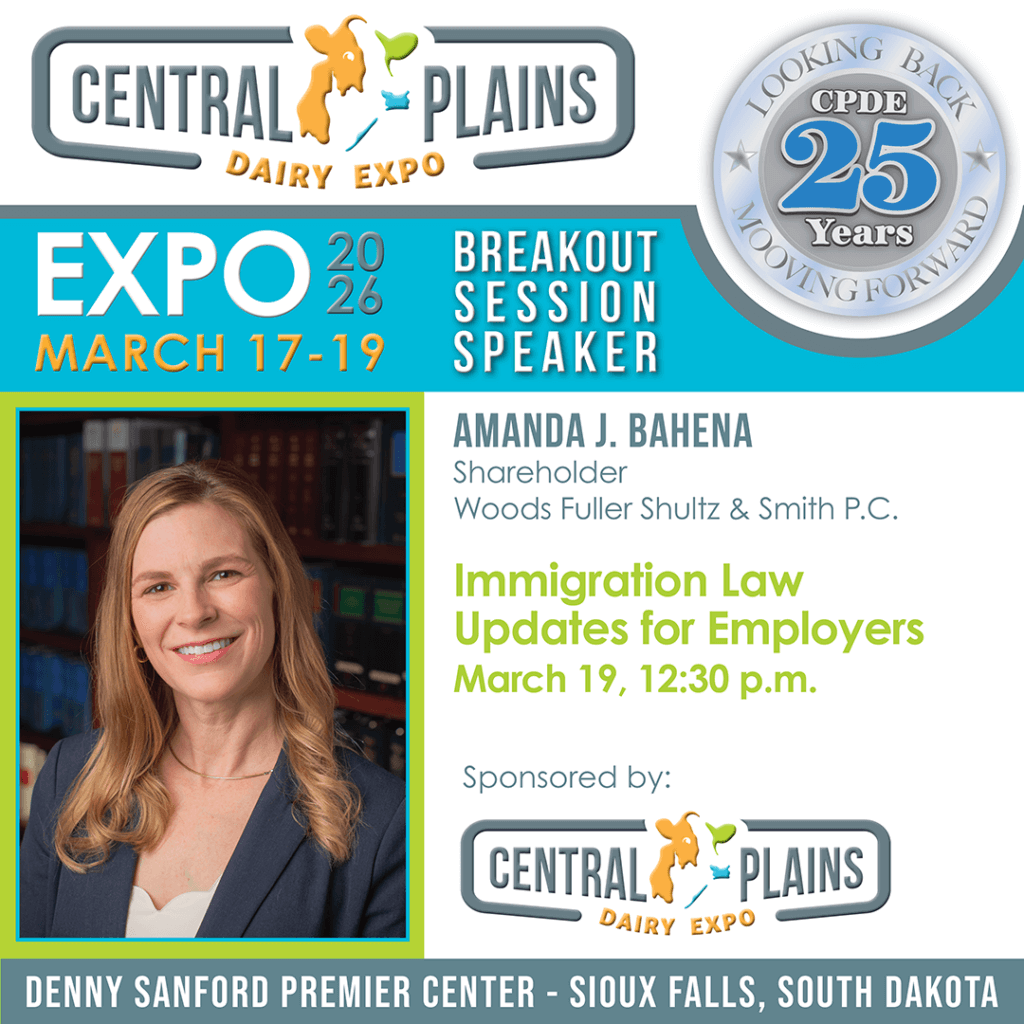
Immigration Law Updates for Employers
Mark Newman
Account Executive, Dairy Team | Commodity & Ingredient Hedging
This presentation will provide employers with a practical overview of recent and upcoming developments in U.S. immigration law that impact the workplace. The session will focus on employer compliance obligations, including proper completion and maintenance of Form I-9, evolving work authorization requirements, and best practices for avoiding discrimination while verifying employment eligibility. It will also address worksite enforcement trends, including audits, investigations, and government inspections, and offer guidance on how employers can prepare for and respond to enforcement actions. Attendees will leave with actionable strategies to reduce risk, strengthen internal processes, and ensure ongoing compliance in a rapidly changing immigration landscape.
Amanda J. Bahena is a shareholder at Woods Fuller Shultz & Smith P.C., where she focuses on immigration law. She advises employers nationwide on hiring and retaining foreign-born talent, employment‑based visas, and Form I‑9 compliance, and frequently provides training to help organizations navigate today’s evolving regulatory landscape.
In addition to her employer-focused work, Amanda represents individuals in family-based immigration, student visas, waivers, adjustment of status, and immigration court proceedings. This broad experience gives her a comprehensive understanding of both organizational and individual immigration challenges.
Amanda’s background also includes estate planning, corporate law, real estate, and family law, allowing her to deliver practical and well‑rounded legal guidance. She holds degrees from Iowa State University, the University of Warwick, and the University of Iowa College of Law.
Active in the legal community, Amanda is involved with the American Immigration Lawyers Association and serves on the State Bar of South Dakota Immigration Law Committee. She was also appointed to the American State Bank Board of Directors.
Known for her clear communication and practical approach, Amanda is committed to helping employers understand the legal landscape and confidently manage their workforce needs.

Dairy’s Rising Leaders: Conversations We Need to Have
Moderator:
Peggy Coffeen
Founder and Host | Uplevel Dairy
Panelists:
Jacob Weg
Weg’s Blue and White Dairy
Emma Brockshus
Brockshus Dairy
Emmett Meissner
Norm-E-Lane Farm
Chelsea Abbott
Trans Ova Genetics
This panel features four young dairy leaders who are in the thick of it: managing big career decisions, juggling work and personal life, building confidence and learning how to work alongside different generations on farms and in agribusiness.
Peggy Coffeen from Uplevel Dairy will facilitate the conversation with key takeaways on:
Insights and confidence from young leaders who have learned through real-world challenges and are willing to share what they wish they’d known sooner
Practical strategies for navigating early-career transitions, including changing roles, switching employers or stepping into leadership
Tools for balancing work and life, especially when managing the demands of young families, on-farm responsibilities and career growth
Communication approaches for working effectively across generations

Where to Start: Building an Enhanced Biosecurity Plan
Danelle Bickett-Weddle
Owner | Preventalytics
Miquela L. Hanselman
Director, Regulatory Affairs | National Milk Producers Federation
Let’s make writing a biosecurity plan feel less like a “mountain” and more like a “molehill.” This session will help the audience identify risks specific to their herd and create workable, farm-specific practices. Using real dairy farm examples, the presenters will highlight common challenges, practical solutions and how to prioritize seeing results. Participants will leave with the knowledge and resources to build biosecurity plans for daily use that can be scaled up if a highly contagious disease threatens their dairy herd.
Danelle Bickett-Weddle is a veterinarian with more than 25 years of experience promoting livestock health through action. Bickett-Weddle with Preventalytics, a company she founded, supports livestock producers and decision-makers interested in business continuity. Her clients include the National Milk Producers Federation, National Cattlemen’s Beef Association, American Sheep Industry Association and several state departments of agriculture, working Secure Food Supply outreach and education. She was a practicing veterinarian in South Dakota and a nutritionist for Land O’Lakes/Farmland Feed in the Upper Midwest prior to her academic career at Iowa State University. Her first-hand experience in agriculture, training in public health and board certification in veterinary preventive medicine, and common-sense approaches allow her to successfully connect with audiences and clients. While her formal education occurred in South Dakota and Iowa, her informal education is ongoing.
Miquela Hanselman joined the National Milk Producers Federation (NMPF) in 2019 as its director of regulatory affairs, leading NMPF’s regulatory-focused efforts on nutrition and public health, including the Dietary Guidelines for Americans. She also oversees NMPF’s efforts for the National Conference of Interstate Milk Shipments, multi-sector Tuberculosis Working Group and NMPF’s internship program. Furthermore, she is the program lead for Farmers Assuring Responsible Management (FARM) Biosecurity, focused on protecting the health of dairy farmers’ herds and employees. Hanselman received her bachelor’s degree in animal science and master’s degree in public health, with a concentration in food systems from Cornell University. Growing up on a dairy farm in Upstate New York, which is still operating today, she is thankful for the opportunities that being a part of the dairy industry has given her.

DeLaval Way of Milking: Producer Experiences with Flow-Responsive Milking
Andy Johnson
Dairy Consultant
Ryan Lepeska
Lepeska Dairy Farms
William Walleser
Wall-Stone Holsteins LLC
In this session, dairy producers William Walleser of Wall-Stone Holsteins LLC and Ryan Lepeska of Lepeska Dairy Farms, along with Andy Johnson, DVM, will share their firsthand experiences using DeLaval’s Flow-Responsive Milking on rotary and robotic systems. Join us to learn how this technology has elevated milking routines and helped on-farm performance.
Andy Johnson, “The Udder Doctor,” is a Green Bay, Wis.-based veterinarian specializing in milk quality, parlor performance and cow comfort. Prior to retiring from full-time work, he served as the herd health and wellness veterinarian for Grande Cheese Company. He has consulted worldwide, working in 30 countries and 46 states on dairies ranging from 20 to more than 20,000 cows. A former president of the National Mastitis Council (NMC) and Wisconsin Veterinary Medical Association, Johnson helped develop the U.S. standards for airflow protocols in milking systems. His career achievements include the American Association of Bovine Practitioners Practitioner of the Year award, Wisconsin Veterinarian of the Year, Quality Veterinarian of the Year and NMC Award of Excellence.
Ryan Lepeska, Stitzer, Wis., owns and operates Lepeska Dairy Farms, a 190-cow herd, with his father and sister. His commitment to agricultural technology and efficiency is evident in his early adoption of robotic milking systems, having installed three DeLaval robots in 2008 and upgrading to the advanced DeLaval V300 system in 2020. Under his stewardship, Lepeska Dairy Farms has achieved remarkable productivity, with the herd averaging 2.9 milkings, 95 pounds of milk per cow per day and a somatic cell count of 100,000. This impressive business reflects their expertise in herd management, nutrition and strategic integration of traditional farming practices with modern agricultural technology.
William Walleser farms in partnership with his parents at his family’s dairy, Wall-Stone Holsteins LLC, in De Soto, Wis. The farm milks 1,500 cows and farms 2,200 acres. Walleser oversees the cropping program, nutrient management, permitting, construction projects and is active in herd management and farm finances. He is actively involved in building the long-term strength of the operation through herd genetic development and on-farm infrastructure development. Walleser participates in local farm programs, including Vernon County Farm Bureau and Dairy Farmers of America Young Cooperators.
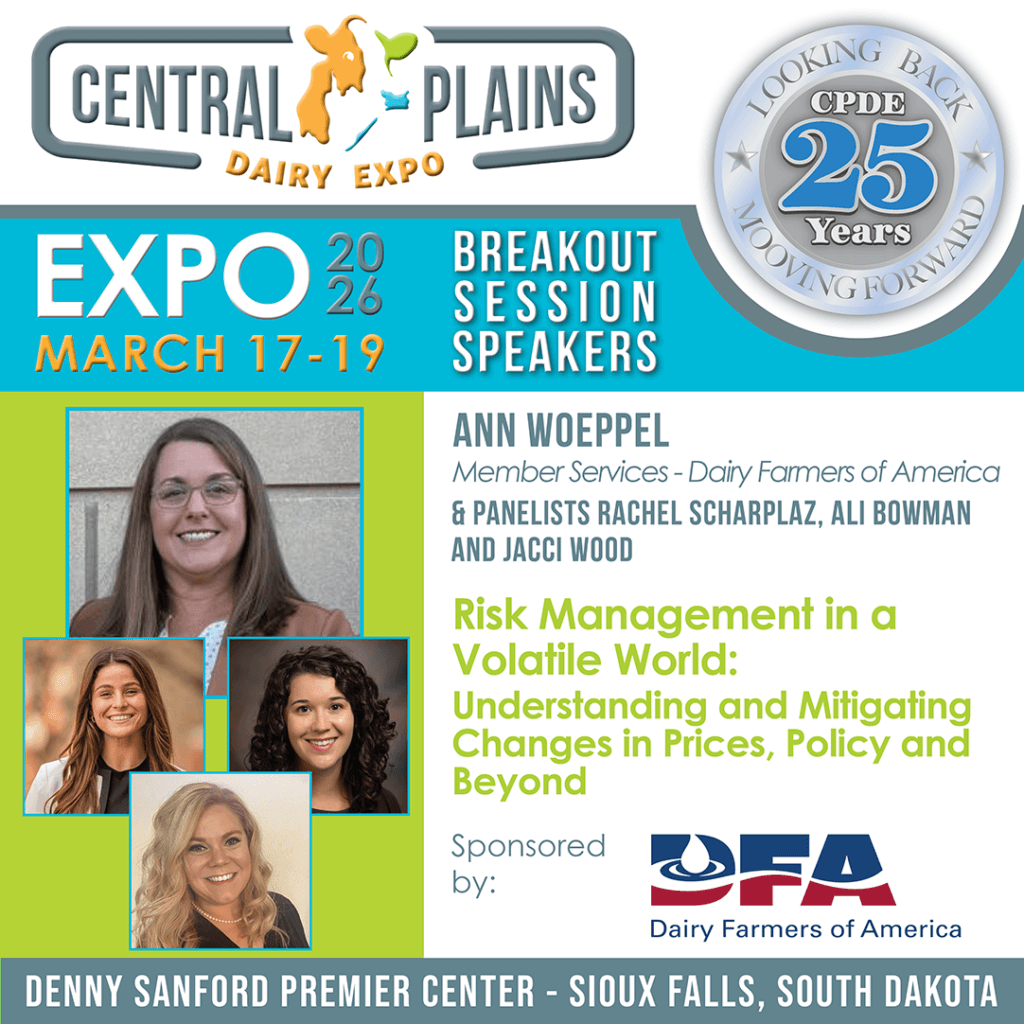
Risk Management in a Volatile World: Understanding and Mitigating Changes in Prices, Policy and Beyond
Moderator: Ann Woeppely
Manager Member Services | Dairy Farmers of America
Panelist: Ali Bowman
Farm Practices Coordinator | Dairy Farmers of America
Panelist: Rachel Scharplaz
Strategic Relationship Manager | Dairy Farmers of America Risk Management
Panelist: Jacci Wood
Insurance Agent | Agri-Services Agency
From market swings to regulatory shifts, the dairy industry is ever changing and some of these changes pose a major challenge for your business. This panel discussion will explore dynamics that may be poised to bring the biggest challenges to dairy farmers in 2026, as well as ways to reduce uncertainty on your farm. This comprehensive risk management overview spans milk and beef price outlook, changes in the insurance landscape and labor and workforce issues.
Ann Woeppel has spent 17 years as a field representative with Dairy Farmers of America (DFA). In this role, she acts as a liaison for DFA farmer-owners, sharing cooperative news and industry updates, and helping with quality and regulatory matters. In addition to her DFA role, Woeppel is a FARM (Farmers Assuring Responsible Management) trainer and an evaluator for DFA’s Central Area, where she offers guidance and feedback to co-evaluators and the farmer-owners she supports. She grew up on a dairy farm in Northeast Iowa and earned her bachelor’s degree in dairy science from Iowa State University.
Ali Bowman supports dairy farmers by connecting them with industry and legal experts, and providing practical resources to help them understand and navigate the evolving farm workforce landscape. Raised on a small dairy in Stillwater, Okla., Bowman has deep roots in the dairy industry and holds a bachelor’s degree in animal science from Oklahoma State University.
Rachel Scharplaz works with DFA farmer-owners to help them understand their milk price and outlook, evaluate the suite of price risk management tools available to them and execute strategies aligned to their goals. Over the past six years, she has partnered with producers to turn complex market information into clear, actionable decisions that strengthen farm resilience. Raised on a beef cattle operation in Western Kansas, she is passionate about animal agriculture and enjoys working with dairy farmers to meet their diverse risk management needs, including growth in cattle price risk management following the expansion of beef-on-dairy breeding.
Jacci Wood has more than six years of experience in insurance and a master’s degree in agricultural education. She is licensed in property and casualty, life and health insurance, and is certified in dairy cattle nutrition, diet formulation and dairy herd management. In addition, Wood holds agribusiness and farm insurance specialist certification, plus specific insurance carrier certifications.

A Farmer-led Solution for an Unpredictable Sustainability Landscape: Decision-Support Scenario Planning with EmPower+
Jennifer Block
Director of Value Chain Partnerships | Edge Dairy Farmer Cooperative
Dairy farmers and processors operate in a marketplace where sustainability expectations are becoming harder to predict. Customer demands shift rapidly. Retailers and brands face pressure from consumers, investors and regulators. And processors are expected to report improved environmental outcomes even as rules, standards and reporting frameworks continue to evolve.
EmPower+ is a new farmer-led, whole-farm program designed to bring clarity and credibility to this uncertainty by supporting on-farm innovation and practical decision-making. Through decision-support scenario planning, EmPower+ uses existing on-farm data to help farmers and processors test management choices before investing capital, specifically to understand how those decisions can improve greenhouse gas emissions and water quality outcomes. In this session, panelists will discuss how EmPower+ provides support for consistent data and how scenario planning can strengthen farm-level decisions and supply-chain reporting, reduce complexity and ensure that farmer-led efficiency gains are recognized across the value chain.
Jennifer Block is director of value chain partnerships, where she leads collaborative initiatives to advance farmer-led sustainability, innovation and market opportunities. Block brings more than 20 years of experience in corporate social responsibility, communications and global policy development across global energy and agriculture sectors.
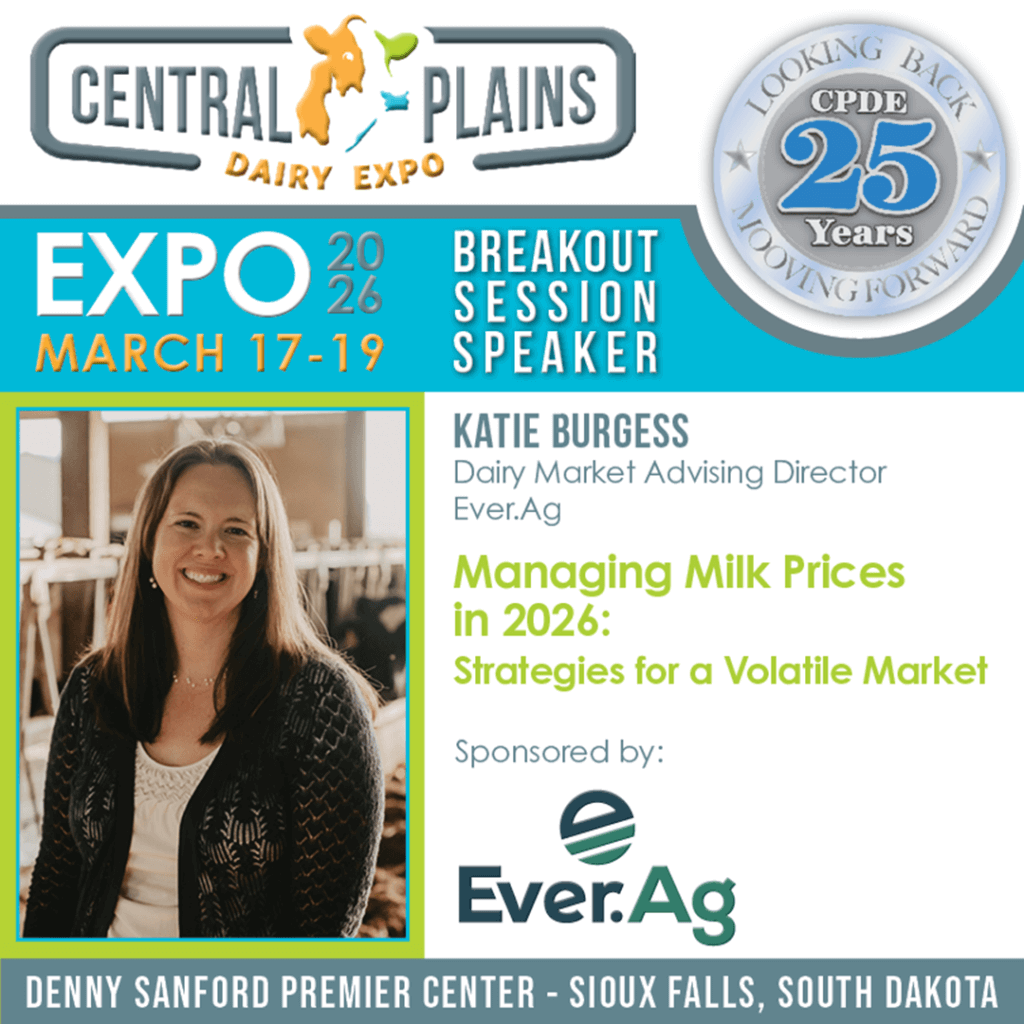
Managing Milk Prices in 2026: Strategies for a Volatile Market
Katie Burgess
Dairy Market Advising Director | Ever.Ag
Milk markets are as volatile as ever, coming off a year with expanded cheese production capacity and record export volumes. Now with the dairy cow herd at its highest level in more than 30 years, how will the markets balance strong milk supply against increased competition in the export market, plus evolving U.S. consumer trends? Get an update on the programs available for dairy producers today – Dairy Margin Coverage, Dairy Revenue Protection (DRP) Insurance, Livestock Gross Margin (LGM) – Dairy Insurance, futures, options and more. But hedging doesn’t need to be complicated; this session will keep risk management simple, straightforward and arm you with what you need to know to implement a successful program on your dairy.
Katie Burgess developed a passion for the industry while growing up on a Wisconsin dairy farm and joined the Ever.Ag team in 2012. She works with clients across the dairy supply chain, including producers, cooperatives, processors, retailers, restaurants and multi-national end-users. As a trained economist and commodity broker, she keeps customers updated on dairy supply and demand fundamentals and helps them manage price volatility via hedging programs. Burgess holds a master’s degree in agricultural and applied economics and a bachelor’s degree in agricultural business management, both from the University of Wisconsin.

From High Prices to High Confidence: Insuring Calf Values with LRP and Managing Feed Markets in 2026
Brandon Weigel
Grain & Feed Market Advisor/Broker & Livestock Agent | Ever.Ag
The long-term bull trend in cattle markets has impacted the dairy industry in a way that few would have anticipated just five years ago. The advent of beef x dairy has not only been the driving force for added revenue at the dairy, but in recent times has been the saving grace of profitability – in spite of softer milk prices. From historical cycle patterns to shifting industry dynamics and mass uncertainty around the longevity of current values, approach 2026 and beyond with confidence that record calf prices can be a sustainable piece of your operation for the foreseeable future. Complementing this strength in cattle values, another added positive amid softer milk has been reasonable feed values, among some of the lowest the industry has experienced in five years. Join us for an insightful discussion on how 2026 feed markets are shaping up alongside cattle trends to impact your bottom line in the year ahead.
Come to this learning session to discover how dairy producers are confidently managing record beef revenue with the new unborn calf and cull cow Livestock Risk Protection (LRP) tool, while also navigating feed market volatility for balanced risk management. With a tilt toward prolonging current calf and cull cow values for as long as possible – and hedging against potential upsides in feed costs – risk management on what is often viewed as a byproduct of the dairy isn’t an area to overlook. What we have today in beef would be the equivalent of receiving more than $30 milk for prolonged periods of time. Pairing that with strategic feed positions can further solidify profitability. The tools are in the arsenal; figure out how to deploy LRP with confidence while managing the topside risk present in current feed values.
Brandon Weigel grew up on his family’s grain and livestock farm in Southwest Wisconsin, where he is actively involved to this day. He started in the commodity risk management world with Ever.Ag during college. Weigel now focuses his time working one-on-one alongside grain, dairy and livestock producers to holistically manage their market risk in grain, feed and cattle. He helps producers navigate markets, understand how to implement the tools available to them and tailor individualized risk management plans with the goal of sustaining consistent long-term profitability and success within each operation.

The State of Dairy: Market Signals and Financial Realities
Matt Erickson
Senior Analyst | Terrain
Ben Laine
Senior Dairy Analyst | Terrain
Tim Van Hofwegen
Vice President Agribusiness Lending | Farm Credit Services of America
What does the year ahead hold for dairy producers? Our panel connects macroeconomic trends to on-farm decisions, offering a clear view of how corn on soybean balance sheets, milk prices and credit conditions influence profitability. With insights from two leading economists and a lender, this session will deliver the critical information you need to make informed decisions and stay competitive in 2026.
Matt Erickson is a senior analyst focusing on macroeconomics and the grain, oilseed and swine sectors. He previously was agriculture economic and policy advisor for AgCountry Farm Credit Services, Farm Credit Services of America and Frontier Farm Credit. He also served as chief economist for the U.S. Senate Committee on Agriculture, Nutrition and Forestry, and an economist at the American Farm Bureau Federation and U.S. Department of Agriculture. In addition to his work as an analyst on commodity markets and farm policy, Erickson remains actively involved in his family farm near Lafayette, Ind. He earned his bachelor’s and master’s degrees in agricultural economics from Purdue University.
Ben Laine is Terrain’s senior dairy analyst. His previous experience includes work as a dairy analyst for Rabobank, a senior economist covering the dairy industry at CoBank and a commodity hedging manager and economist at Agri-Mark dairy farmer cooperative. While at Agri-Mark, he developed a tool for dairy producers to manage their milk price risk. Laine has also developed trading and risk management programs for commercial dairy commodity businesses, produced price forecasts and provided economic outlooks. His research has spanned the dairy supply chain, consumer trends, methane reduction and export markets. Laine earned his master’s degree in resource economics at the University of Massachusetts-Amherst.
Tim Van Hofwegen is an agribusiness lending vice president with more than 25 years of experience at Farm Credit. Raised on a dairy farm in Arizona, he combines agricultural insight with financial expertise to support agribusiness success.
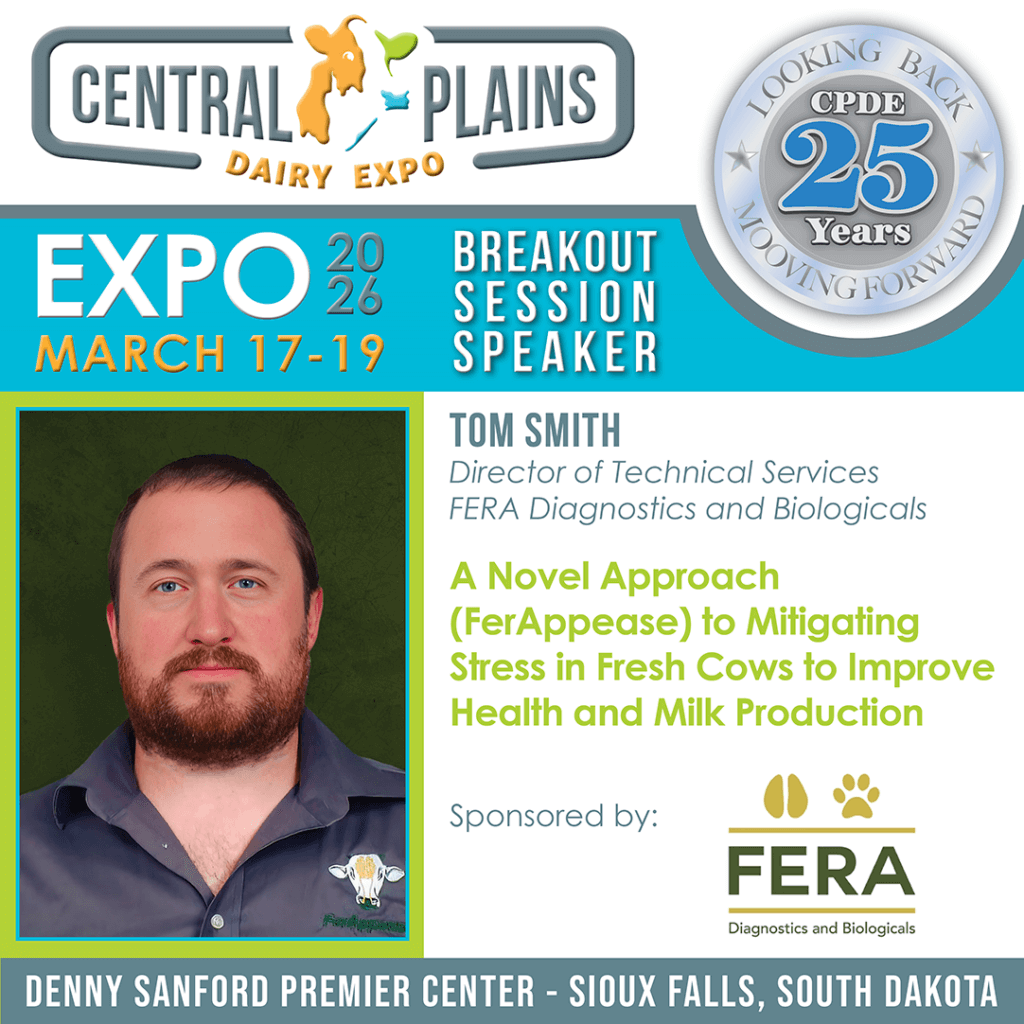
A Novel Approach (FerAppease) to Mitigating Stress in Fresh Cows to Improve Health and Milk Production
Tom Smith
Director of Technical Services | FERA Diagnostics and Biologicals
This presentation will focus on the changes that occur in the fresh cow due to stress hormones and ways in which we can mitigate these effects to improve health and production. A special emphasis will be placed on the recent research trial conducted by Jose Santos, University of Florida, in three California dairy farms demonstrating the game-changing potential that FerAppease has as a novel fresh cow intervention.
Tom Smith currently serves as the director of technical services for FERA Diagnostics and Biologicals. Smith has been involved in the cattle industry his whole life, growing up on his family’s seedstock operation. He studied dairy science at Cornell University before staying four more years to attend veterinary school, where shortly before graduating, he co-founded FERA Diagnostics and Biologicals with Rodrigo Bicalho. Smith worked in large animal practice as a cattle veterinarian for several years, founding his own successful large animal clinic, which his wife still runs. He focused on herd consultations for beef and dairy cattle, and advanced reproductive techniques in private practice, before deciding in 2022 to dedicate his full attention to FERA. Smith has spent the past three years traveling the country training veterinarians and helping producers mitigate stress in their production systems.

The Alfalfa Advantage: What Smart Field Decisions Mean for Your Bottom Line
Moderator:
Erika Rodbell
Forage Research Agronomist | Forage Genetics International
Panelists:
Sara Bauder
Forage Field Specialist | South Dakota State University Extension
Dan Funke
Forage Producer | Funke Farms
Greg Moes
Dairy Producer | MoDak Dairy
Growers and producers across regions are navigating an evolving set of in field challenges—from stand establishment and traffic stress to pest pressure and weather variability. In this session, a forage specialist, a hay grower, and a dairy producer share practical management approaches that strengthen alfalfa’s role in the ration and on the farm. We’ll explore field management strategies, how to optimize quality and yield in your alfalfa production, and the links to soil health and integrated pest management. Expect real world examples, actionable takeaways, and time for Q&A so you can bring home ideas that fit your operation—whether you’re focused on agronomy, forage quality, or dairy performance.
Erika Rodbell is a forage research agronomist at Forage Genetics International (FGI). Rodbell is responsible for using applied research experience in sustainable agriculture and pest management to provide education and training around alfalfa pest management to agronomy retailers and producers. She earned her bachelor’s degree in conservation biology from St. Lawrence University, her master’s degree in entomology and sustainable agriculture from Iowa State University, and her PhD from Montana State University-Bozeman, where she researched pyrethroid resistance in the alfalfa weevil across the Intermountain West.
Sara Bauder has been with South Dakota State University (SDSU) Extension since August of 2016. She initially worked as an agronomy field specialist and most recently serves as forage field specialist. Bauder primarily focuses on warm and cool season annual forage production (cover crops), alfalfa production and alternative forages. She promotes maintaining healthy soils and regenerative agriculture management. Much of Bauder’s time is spent working with producers, speaking at or hosting events, and writing articles. Previously, she worked as a soil fertility research assistant at SDSU in Brookings. Bauder’s love for agriculture comes from her time growing up on a farm near Baltic, S.D., which she now owns and manages in partnership with her sister. Bauder earned a bachelor’s degree in agriculture education and a master’s degree in plant science – both from SDSU.
Dan Funke is a forage producer in Northeastern Iowa.
MoDak Dairy is a dairy, beef and cropping operation located near Goodwin, S.D. Greg and his brother Jim are fourth-generation farmers and Greg’s son Jacob, the fifth-generation, own and operate the business, along with all the families involved in making the operation a success. The farm has been in the Moes family for 130 years. MoDak Dairy milks 2,500 Holstein cows three times a day, farms 4,000 acres of corn, alfalfa and sorghum, and raises beef-on-dairy from birth to finish weights. In 2021, MoDak Dairy built and finished a new calf and heifer facility. At that time, MoDak switched to Akaushi crossed with Holstein breeding. In 2022, MoDak Dairy went from Limousin to Angus and Akaushi crossed breeding. Currently, MoDak Dairy has 3,000 head on feed from birth to finish.

The Zero-Cost Dairy Tune-Up: Communication, Consistency and Collaboration
Mario Solis
Technical Service Consultant | Form-A-Feed
Learn how to improve milk, labor performance and feed efficiency using management discipline – not capital investment – by tightening communication, expectations and daily execution.
Mario Solis brings more than 24 years of hands-on dairy industry experience, including the past nine years with Form-A-Feed. He holds a degree in animal science from the Instituto Tecnológico y de Estudios Superiores de Monterrey in Mexico. Solis has worked in every phase of dairy operations – from entry-level positions to management – gaining deep experience in start-ups, expansions, staffing, training and team development. His background includes managing large Midwest dairies and serving as a milk quality specialist, overseeing 16,000 cows. His career has taken him across the United States and around the world, helping dairies improve performance through practical, people-focused management. Solis has a strong understanding of cows, people, equipment and how they interact, enabling him to drive measurable results and elevate dairy operations of all sizes.

Keep the Farm in the Family – And the Family on the Farm®
Craig Sorenson
CEO | Financial Wealth Solutions
You’ve poured years – maybe generations – into your farm. The land, the operation, the family name… it all matters. But one hard truth catches many families off guard. Most farms don’t make it past the third generation – not because the farm failed, but because the plan was never written down. This session is a practical, encouraging conversation about how to pass the farm on with clarity and peace – so the farming heir(s) can keep operating, non-farming children feel respected and treated fairly, and Mom and Dad can retire with confidence. Sorenson creates a safe, straightforward space to talk about the planning steps that keep the farm operating and the family connected. He’ll break down the big questions into clear decisions, so you can move forward with confidence – without losing what matters most. If you want to protect your legacy, reduce confusion and keep relationships strong while building a plan that works in the real world, this presentation is for you.
Craig Sorenson is the founder of Financial Wealth Solutions and a lifelong advocate for agricultural families and business owners. Raised on a South Dakota farm, Sorenson brings more than 40 years of experience helping clients protect their land, businesses and legacies through disciplined financial planning and trusted advice. A graduate of South Dakota State University, Sorenson holds his Series 6, 65, 24 and 26 licenses, along with life, accident and health, long-term care and disability licenses – helping families plan confidently for generations.
Artificial Intelligence on the Farm: A Hands-on Session for Dairy Managers
Andrew Beckel
Founder | Golden Calf Company
Dagmar Beckel Machyckova
General Manager | Golden Calf Company
Artificial Intelligence (AI) is all over the news, but how does a dairy farmer get to take advantage of it? Where does it save time, reduce stress and help your team do better work without adding complexity? Join us for an interactive, hands-on session where we’ll explore real ways dairy farmers can use AI tools to make daily life easier, from communication and protocols to training and data-driven decisions. You’ll see live examples, try prompts that work in the real world and leave with templates you can use immediately. We’ll walk you through how to build your own “Agent” to support your operation and analyze your farm data. We’ll explore ways that it can help develop employee training materials in multiple languages, including quizzes, visual aids and quick-reference guides that actually stick. If you’re curious about AI but want something practical, this session is for you.
Andrew Beckel has transformed how dairy farmers across the United States manage colostrum and care for newborn calves. In 2010, he founded Golden Calf Company in Bloomer, Wis., becoming a passionate advocate for neonatal calf care. He firmly believes in U.S. manufacturing – producing everything from colostrum pasteurizers to bags and tube feeders. Known for his hands-on approach, Beckel goes the extra mile to help farmers enhance their management protocols.
Dagmar Beckel Machyckova is the general manager of Golden Calf Company, a U.S. manufacturer of innovative dairy colostrum solutions based in Bloomer Wis. Beckel Machyckova is a passionate promoter of technology for dairy farm maternity areas. Her innovative spirit has led to groundbreaking products like the Auto Fill Colostrum Station, which is the first in the industry to provide an objective source for colostrum quality and connecting the dam to calf. Beckel Machyckova’s professional interests lie in data-driven innovation, lean manufacturing and organizational systems.
Traffic by Design: Alternative Cow Flow Layouts for Lely Automated Milking Systems
Moderator: Stacie DeGroot
Gorter’s Clay and Dairy/Lely
Panelist: Anton Borst
Halarda Farms, MB, Canada
Cow flow can make an automated milking system feel effortless – or turn it into a daily game of “go find the cows.” Join Gorter’s and Lely for an interactive producer-led session focused on alternative cow traffic (cow flow) designs in an automated milking setup. Hear directly from producer Anton Borst, who has hands-on experience with three different cow flow designs and has lived through the real-world tradeoffs: what changed in cow movement, how much fetching was needed, where bottlenecks formed and which layout made chores smoother (or harder) for the team. We’ll break down the most common cow flow options – from more open, voluntary traffic to more guided or controlled layouts – and discuss how each approach can influence labor demands, daily routines, robot visits and cow behavior (including dominance, hesitation and stall/robot “hangups”). Come ready with your questions, barn layout challenges and goals. This session is built for practical takeaways you can apply back home.
Coming Soon!
Feeding the Future: How Feeding Automation Is Reshaping Cattle Operations
Moderator: Stacie DeGroot
Gorter’s Clay and Dairy/Lely
Panelist: Jeff Bremer
Bremer’s Pine Ridge Farm, Lake City, MN
Panelist: Ben Rein
Rein Dairy, Lanesboro, MN
Panelists: Joseph and Mace Plucker
Red Dog Ranch, Parker, SD
Panelist: Walter Aschoff
Four Aces, Osmond, NE
Step into the barn of tomorrow! Join us for a dynamic and interactive panel discussion where four successful producers will share firsthand experiences with automated feeding technology – how it works, what it looks like in action and why it’s rapidly gaining traction in dairy and beef operations. Automated feeding systems like the Lely Vector combine “feed kitchen” and a mobile mixing feeding robot to mix and deliver precisely blended rations throughout the day – without the constant presence of a tractor or feed wagon. These systems scan feed levels, mix customized rations and push fresh feed to animals 24/7, ensuring feed is always within reach and tailored to the needs of specific groups. During the panel discussion, producers will describe what this technology looks like on the ground – from the robot’s routes through the barn to how daily feeding tasks are transformed when automation takes over. Whether you’re curious about automated feeding or considering making the leap, this panel will deliver real insights, metrics and stories you won’t want to miss.
Coming Soon!

More Forage: Less Input and Managing Fall Harvest Stress
Jeff Jackson
Forage Specialist | CROPLAN – Land O’Lakes
Are there ways of producing more digestible fiber/forage in our systems while reducing our cost per pound of feed fed? Look at some ideas to use alternative practices and forages to achieve that goal. Making a large pile of fiber at a low cost and adjusting the energy of the total mixed ration (TMR) with local inputs will be an advantage. While we look at some transition in harvested product to make that pile of fiber, can we also take some harvest pressure off of the crew in the fall to have a better balance of time and energy?
Jeff Jackson grew up on a livestock/row-crop operation in Northwest Iowa with corn, soybeans, oats, alfalfa, cattle, hogs, sheep and horses. South Dakota State University was the next destination where he earned a bachelor’s degree in animal science and master’s degree in plant science before going back to the country. Starting his ag career as an applicator/feed guy/agronomist/jack-of-all-trades at the local co-op opened many doors and enhanced his academic career. An opportunity in 2005 led Jackson to CROPLAN as a seed district sales manager. Working in a heavy dairy area of I-29 in eastern South Dakota directed him to his current position in 2010 with CROPLAN Seed as an alfalfa and forage specialist and national product manager for forage sorghum. He continues to focus on alfalfa, corn silage, triticale, grain sorghum/MILO and forage sorghum technical support and training opportunities for industry professionals and growers.

Always be Prepared: The Boy Scout Rule as Applied to Your Dairy Operations
Allen Schlenker
Business Insurance Risk Management Consultant | Marsh McLennan Agency
Cameron “Rudy” Rudolph
Farm and Ranch Senior Territory Manager | Liberty Mutual Insurance and State Auto
A disaster of some type is bound to happen in your operations. A natural, workforce or man-made catastrophe can dramatically impact the financial viability of your operation’s future. Having a quality Emergency Action Plan in place prior to a disaster and a well-constructed Emergency Response Plan in place after the event can go a long way to minimizing the disaster’s impact. Cameron Rudolph of Liberty Mutual/State Auto and Allen Schlenker of Marsh McLennan Agency will discuss the importance of establishing an Emergency Action Plan and Emergency Response Plan, their differences and how these can impact both the severity and recovery time from a disaster.
Allen Schlenker is a business insurance risk management consultant for Marsh McLennan Agency, based in Sioux Falls, S.D. He specializes in agri-business-related exposures, with an acute focus on dairy operations. He also works with many agricultural co-ops, grain elevators, feed mills and agronomy centers. Schlenker covers a territory that runs from Southern Kansas up through the Dakotas, and includes Iowa and Minnesota. He spent summers on his grandmother’s and uncle’s farms learning about the various aspects of agriculture, farming in general and the value of a hard day’s work. Schlenker’s goal within the agricultural world is to educate his customers and prospects on current and emerging risk trends, and let them make informed decisions on how they can best manage their business insurance risk exposures.
Cameron Rudolph brings more than 30 years of experience in many facets of the insurance industry, including management positions within loss control, risk management, agency and brokerage production, and sales management. He currently supports agency partners in North Dakota, South Dakota, Minnesota and Wisconsin. Raised in North Dakota, Rudolph’s lifelong passion for farming and the equine community has shaped his career and continues to guide his work. In addition to his current role, he runs cow-calf operations in North Dakota and Arizona, and a full equine training facility. A dedicated educator, Rudolph teaches the Agribusiness and Farm Insurance Specialist (AFIS) designation program, which is open to insurance professionals and farm and ranch risk managers. He has been instrumental in developing a farm and ranch focus in PaceSetter, a year-long training program for new insurance agents specializing in agricultural risks.
Sand Savings: Real ROI from Separation Systems
Renee Schrift
Director of Global Sales – Agriculture | McLanahan Organization
Sand is the best bedding for cow comfort, but hauling, storing and purchasing new sand adds up fast. What if you could cut those bedding costs while also reducing wear and tear on your equipment? In this session, we’ll dig into the numbers and the day-to-day realities of system management and operations. We’ll dive into the financials from a top-level view and then break it down into what operations look like after one year, five years and 10 years of owning a system.
Key discussion topics include:
• System overview: Options ranging from 500-cow to 7,000-cow dairies
• Costs: Initial investment and ongoing operational expenses
• Maintenance: What to expect from year to year, including upkeep and labor considerations
• ROI: How the investment pays back over time
We’ll also hear directly from producers who own and operate sand separation systems. Whether you’re running a smaller herd or managing thousands of cows, this session will give you a clear picture of how sand-manure separation can impact your bottom line and daily operations.
Renee Schrift is the director of global sales for McLanahan Corporation. Since joining the company in January 2001, Schrift has worked to expand McLanahan’s customer base and dealer network, and she continues to serve as a resource for dairy producers. She now leads the Agricultural Systems Business Unit, further developing the brand’s global growth. Schrift attended The Pennsylvania State University, where she attained a bachelor’s degree in dairy and animal science.
The Ear, Nose and Throat Problems of Dairy Calves
Jeremy Schefers
Technical Services Veterinarian | Merck Animal Health
More than 80% of livestock disease involves the lungs and digestive track. When there is a problem in the chest or abdomen, we often forget to look upstream. Problems in the head can lead to problems downstream. This presentation will review common problems that impact the ears, nose and throat of dairy calves. Troubleshoot common practices that contribute to ear, nose and throat problems in dairy calves. Recognize diseases that impact the head of calves. Understand teeth function and development of calves.
Jeremy Schefers is a technical services veterinarian with Merck Animal Health. Prior to Merck Animal Health, he was a food animal diagnostic pathologist at the University of Minnesota Veterinary Diagnostic Laboratory and a calf research and technical specialist with Actus Nutrition. His professional interest includes infectious diseases of cattle.

Technologies and Reproductive Hormones: What’s the Sweet Spot?
Douglas Duhatschek
Technical Services Manager | Parnell Living Science
The first part of the presentation will introduce the concept of targeted reproductive management. During the literature review, we will explore multiple strategies, including the strategic use of CoSynch protocols guided by estrous intensity measured through activity monitoring systems, as well as approaches that use fertility protocols for first service but prioritize breeding on observed estrus, rather than relying solely on timed artificial insemination (TAI). The second part of the presentation will focus on an evaluation of 49 farms that currently use activity monitoring systems but differ in how they manage first-service breedings. Some rely primarily on estrous detection, whereas others use TAI. We will discuss the benefits, challenges and opportunities associated with each strategy.
Douglas Duhatschek is a veterinarian from Brazil with a PhD in animal science from Texas A&M University, specializing in dairy nutrition. He has worked in academia (Texas A&M University, Cornell University and Kansas State University) and industry (Boehringer Ingelheim and Select Sires Brazil). His experience includes providing research, extension and technical consulting support to dairy farmers. His knowledge spans nutrition, management, health and reproduction, with a focus on improving efficiency and profitability in dairy operations. His passion for the dairy industry is best highlighted by his dedication toward education and training programs for dairy workers and students.
Optimizing Calf Health: Strategies for Growth and Disease Prevention
James D. “Jim” Quigley, III
Managing Director | Calf Notes Consulting, LLC
This presentation will address the cost of coccidiosis. For U.S. dairy producers, the cost of coccidiosis is estimated at $100 million. Coccidiosis impacts calf weight gain, feed efficiency, morbidity and mortality. In this session, Quigley will discuss effective control of coccidiosis in calves.
Jim Quigley is managing director of Calf Notes Consulting, LLC, an advisory and consulting firm. His primary role is to lead the company and its activities, including consulting with dairy farms and calf ranches and businesses that support the dairy industry. He provides educational content through his website and custom consulting services to clients all over the world. Also, Quigley serves as an adjunct professor at the University of Florida. Previously, he was the technical lead for Cargill Animal Nutrition in the area of young animal nutrition. Quigley also served as vice president and director of calf operations for APC, Inc. Additionally, he has worked for Diamond V Mills and the University of Tennessee. Quigley received his PhD from Virginia Tech in 1985 and bachelor’s and master’s degrees from the University of New Hampshire.
Novel Liquid Approaches to Improve Transition Cow Performance: DCAD, Phosphorus Binder and Beyond
Kai Yuan
Senior Research and Technical Advisor | Quality Liquid Feeds Inc.
This presentation will talk about the benefits of molasses-based liquid feeds on improving transition cow performance. When fed properly to transition cows, liquid feeds improve feed intake and milk production. Research and on-farm case studies will be presented on novel products, including liquid DCAD (dietary cation-anion difference) and liquid phosphorus binder products to mitigate milk fever. Overall, the audience will learn about the advantages of cost-effective liquid approaches to reduce transition issues and enhance cow performance.
Kai Yuan serves as the senior research and technical advisor of Quality Liquid Feeds Inc. He received his master’s degree in dairy science from the University of Wisconsin-Madison in 2011 and a PhD in dairy nutritional physiology from Kansas State University in 2014. He published more than 15 peer-reviewed journal articles and won numerous national awards. Yuan has been with Quality Liquid Feeds for more than 10 years. He provides on-farm nutritional support to dairy nutritionists and producers throughout the nation.
Combatting Hypocalcemia in Dairy Cows
Jesse Goff
Professor Emeritus | Iowa State University College of Veterinary Medicine
Clinical hypocalcemia (milk fever) and subclinical hypocalcemia of dairy cows are well recognized health challenges. Two major advances in prevention of hypocalcemia are the advent of anionic diets and more recently the Ca/Phos binder diets. The pros and cons of each diet strategy, along with common problems observed with farms trying to implement these diets, will be discussed. Oral calcium boluses are often used by themselves or in conjunction with diet strategies to reduce hypocalcemia. A new approach has been developed, utilizing a plant source of the bioactive form of vitamin D in a bolus to reduce hypocalcemia and this product will be introduced.
Jesse Goff worked at the National Animal Disease Center, U.S. Department of Agriculture (USDA), on farm animal metabolic diseases, including milk fever and hypocalcemia of dairy cows, rickets and other bone diseases, and protein and energy metabolism related to ketosis and immune function. Goff also studied the immune system of cattle and demonstrated that mastitis, retained placenta and metritis are associated with excessive immune suppression in the transition period. After 28 years with USDA, Goff worked for West Central Farmer’s Co-op to produce the anionic product called Soychlor. In 2008, Goff began research and teaching at the Iowa State Veterinary College, where he taught physiology, nutrition and transition cow health. Goff retired to his own barn lab where he developed products related to vitamins D and E for swine, and a Solanum glaucophyllum bolus to reduce hypocalcemia in dairy cows.

The 21-Day Window: Maximizing Profitability in the Transition Period
Julie Veldhuis
Regional Director, Western Customer Support | smaXtec
Brian Sanford
Eastern U.S. Team lead | smaXtec
What if you could see what’s happening inside the cow before and after freshening? The transition period is a critical window where small changes can drive long-term outcomes. What occurs in the days before and after calving often sets the trajectory for the entire lactation, yet early warning signs for potential issues are often missed. In this session, the presenters will take a closer look at the 21-day transition window to show how continuous internal cow monitoring brings hidden health challenges to the surface sooner and replaces guesswork with clarity. Learn how early detection and faster decision-making can protect cow health and uncover hidden profit potential.
Julie Veldhuis brings a lifetime of dairy experience and a passion for data-driven herd management. Raised in a multigenerational dairy family, she has dairied in California, New Mexico, Idaho and Wisconsin, giving her a broad perspective on today’s dairy challenges. Veldhuis has held leadership roles with the United Dairyman of Idaho, National Dairy Board, Dairy Farmers of Wisconsin and Dairy Girl Network. At smaXtec, she works with herd managers, nutritionists and veterinarians to improve herd health and performance with continuous internal health monitoring.
Brian Sanford brings deep-rooted dairy experience and a passion for herd health innovation. With dairy farming on both sides of his family, Sanford spent 16 years in the nutrition and forage sector helping producers improve forage quality and feeding strategies. Since joining smaXtec in 2022, he has worked with dairy herds across the United States, helping producers use early detection and internal health monitoring to improve herd health, reduce involuntary culling and enhance milk quality.

A ‘Fresh’ Perspective on Gender-sorted Semen
Eric Zwiefelhofer
Central U.S. Sales Manager | STgenetics
Gender-sorted semen has drastically improved over time. So, what’s next? How do we continue to improve innovation with sexed semen? This presentation will explore the advancements and future directions in gender-sorted (sexed) semen technology. It highlights improvements in sorting processes and teases innovations like fresh semen applications. Hear about fresh sexed semen research trials – with both dairy and beef-on-dairy applications. Most importantly, learn about the economic benefits of improved fertility and the potential for fresh sexed semen to outperform traditional frozen options in dairy and beef systems.
Eric Zwiefelhofer is originally from northwestern Wisconsin where he grew up on a dairy farm. He earned his bachelor’s degree in dairy science from the University of Wisconsin-River Falls in 2015. He then continued his education at the University of Saskatchewan in Canada where he earned his PhD in veterinary biomedical sciences in 2020. His PhD research focused on ovarian synchronization prior to embryo collection and fixed-time artificial insemination (TAI) in cattle. After his PhD, Zwiefelhofer completed a postdoc, developing protocols for oocyte collection, embryo transfer and fixed-TAI in bison. He joined the STgenetics team in 2022.

8 Seconds • 8 Ball • 8 Pounds
Keith Sather
President | KS Dairy Consulting, Inc. and Supervisor Systems
Boosting the fat and protein content in milk isn’t just a nutritional upgrade; it’s a strategic move that strengthens both herd performance and long-term farm sustainability. When producers focus on the small, consistent habits, protocols and culture that add up to 8 pounds of fat and protein – from fine-tuning feed rations to improving how feed is mixed and delivered – they build a foundation that pays off day after day. These incremental gains mirror other forms of disciplined success; for example, the rider making an 8-second ride and the player who sinks the 8 ball under pressure. Both rely on preparation, awareness and smart choices. In the same way, making thoughtful decisions about the diet and consistently monitoring performance turns small improvements into meaningful, measurable progress.
Keith Sather is the owner and creator of KS Dairy Consulting and Supervisor Systems. A 1984 graduate of the University of Wisconsin-River Falls with a degree in animal science, Sather began his career with nine years in the feed industry before founding KS Dairy Consulting, where he focused on dairy nutrition and responsible management practices. Shortly after establishing Supervisor Systems, he developed Feed Supervisor, Hoof Supervisor and Truck Supervisor – tools that have become widely used across the industry. Today, Sather works with dairy producers, consultants and hoof trimmers around the world, driven by a deep commitment to excellence and innovation.
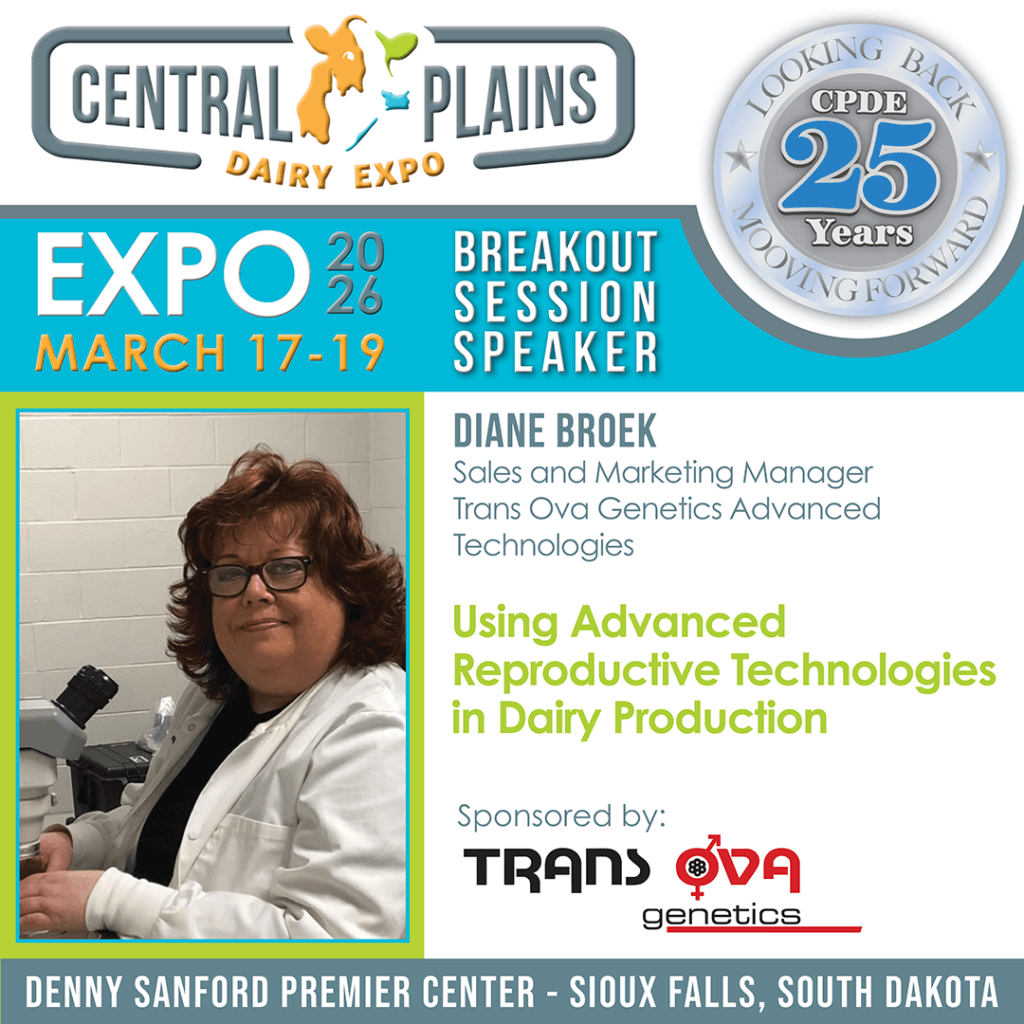
Using Advanced Reproductive Technologies in Dairy Production
Diane Broek
Sales and Marketing Manager | Trans Ova Genetics Advanced Technologies
This presentation will include a review of how progressive producers are using the tools, such as embryo transfer (ET), in vitro fertilization (IVF), sexed semen, cloning and gene editing (GE), in the assisted reproductive technology (ART) toolbox today, and what you could see in the future.
Diane Broek is the sales and marketing manager for Trans Ova Genetics (TOG) Advanced Technologies. She has been with the company since its beginning in 1980 after graduating from Northwestern College with degrees in biology, chemistry and animal science. She will complete her MBA in May 2026. Broek has worn a variety of hats at TOG, including embryologist, lab manager, Midwest area sales manager and general manager for Bovance – a cloning joint venture. She has worked with livestock in ET, IVF, cloning and GE, and is an expert on animal cloning for dairy and beef cattle, pigs, sheep and goats. Also, Broek serves as an ambassador for TOG – giving 50 to 100 tours per year at the TOG facility and discussing ART.
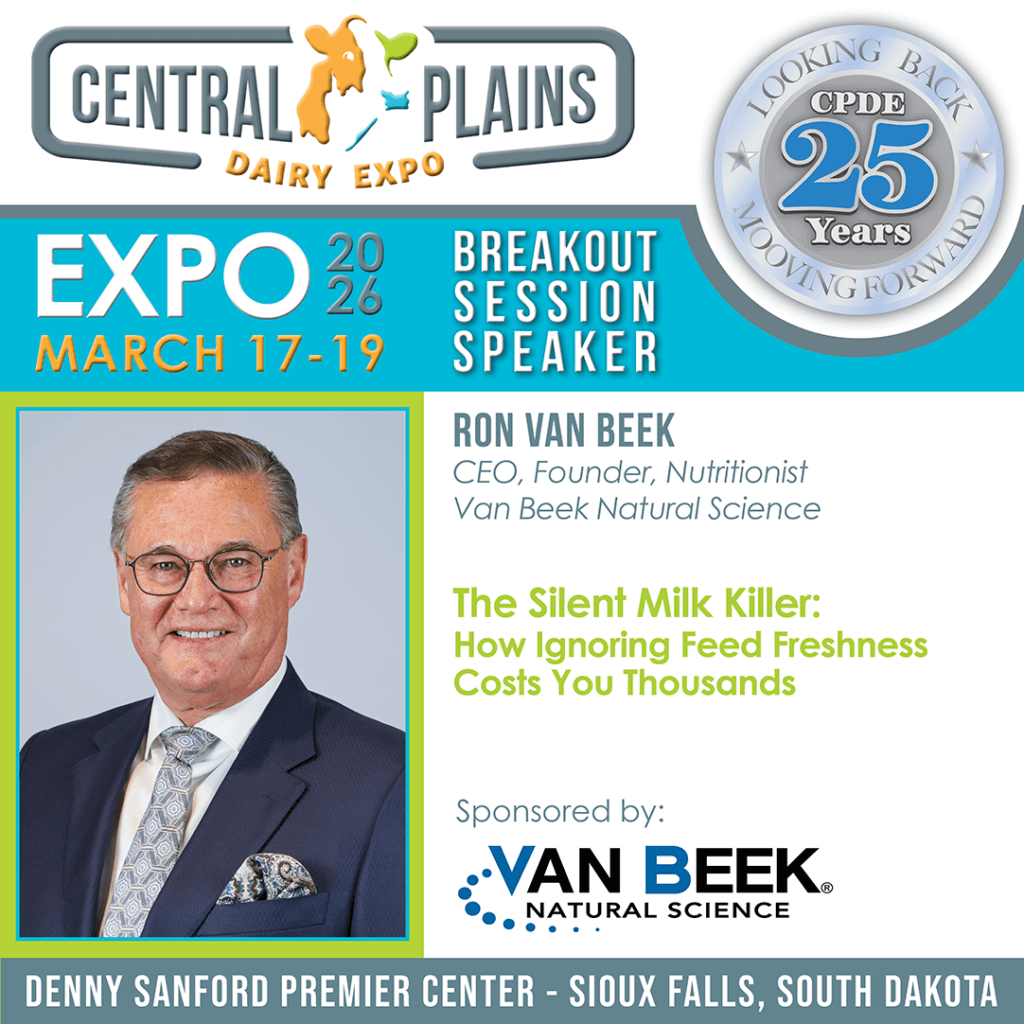
The Silent Milk Killer: How Ignoring Feed Freshness Costs You Thousands
Ron Van Beek
CEO, Founder, Nutritionist | Van Beek Natural Science
This presentation examines the often-overlooked impact of feed freshness on dairy performance and profitability. The session highlights how small, gradual declines in feed quality influence intake, production and ration efficiency, and it breaks down the underlying science in a straightforward, practical way. Attendees will gain a clearer understanding of where hidden losses occur and what management practices help preserve feed value and protect milk output.
Ron Van Beek is the founder and CEO of Van Beek Natural Science, a leader in natural, science-based livestock and companion-animal nutrition and health. With decades of experience as a livestock nutritionist and entrepreneur, he has dedicated his career to developing innovative, natural approaches that improve animal health, feed value and performance.
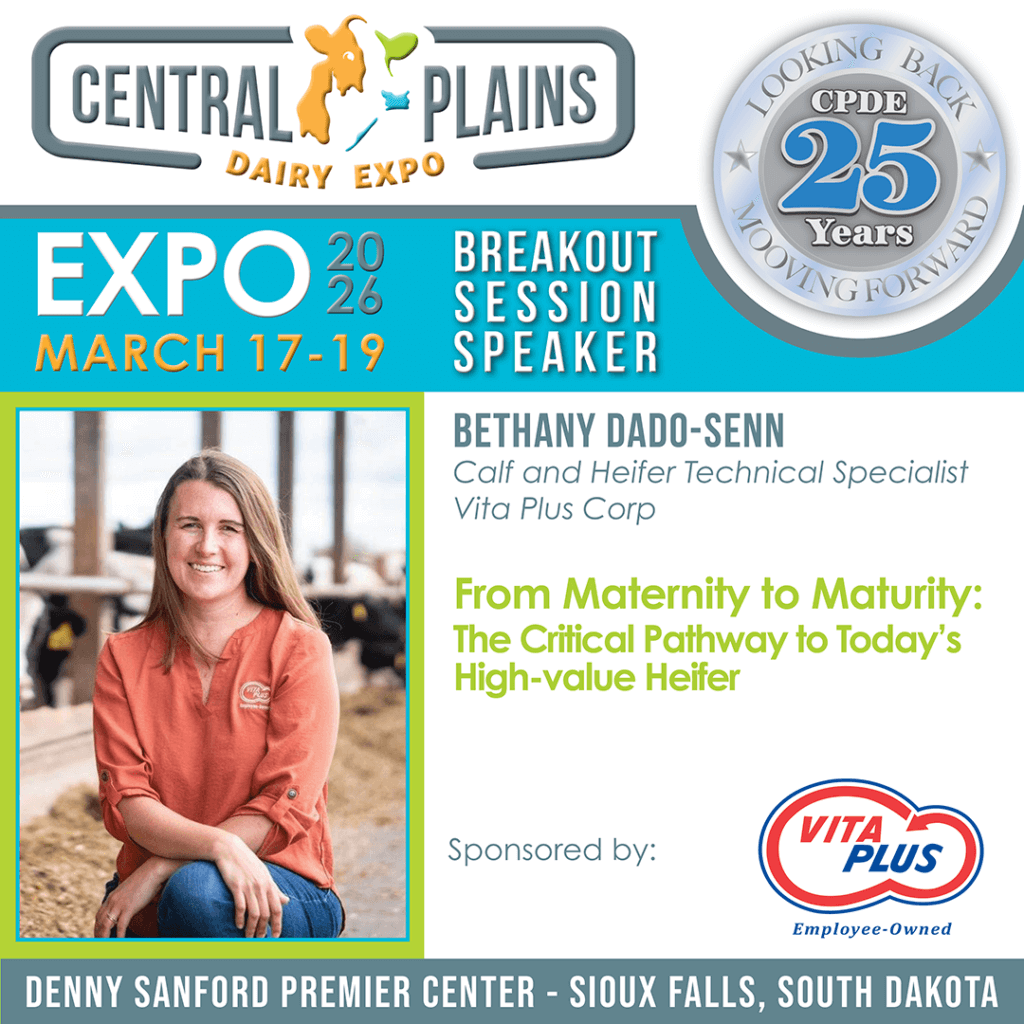
From Maternity to Maturity: The Critical Pathway to Today’s High-value Heifer
Bethany Dado-Senn
Calf and Heifer Technical Specialist | Vita Plus Corp
Heifers are the future of your herd—and their value has never been higher. In this presentation, Bethany focuses on some of the common pitfalls in capturing positive returns in youngstock rearing. She will identify solutions to reduce mortality and drive performance through the entire growth journey: maternity management, pre-weaning performance, and post-weaned heifer health. Discover how to turn today’s calves into tomorrow’s high-producing cows.
Upon attending this breakout, participants will be able to:
– Recognize common areas of value loss in heifer rearing
– Name and apply best practices for pre-weaned calf care
– Identify culprits of poor post-weaned heifer performance
Bethany Dado-Senn is a calf and heifer technical specialist for Vita Plus Corp, partnering with dairy farmers across Wisconsin, Minnesota and South Dakota to raise healthy, productive calves. She is passionate about turning research into practical strategies that make an impact on the farm. Raised in northwestern Wisconsin, Dado-Senn still manages calves on her family’s 500-cow dairy. She earned her bachelor’s degree and PhD from the University of Wisconsin-Madison and a master’s degree from the University of Florida, where she studied how heat stress impacts early-life calf development.
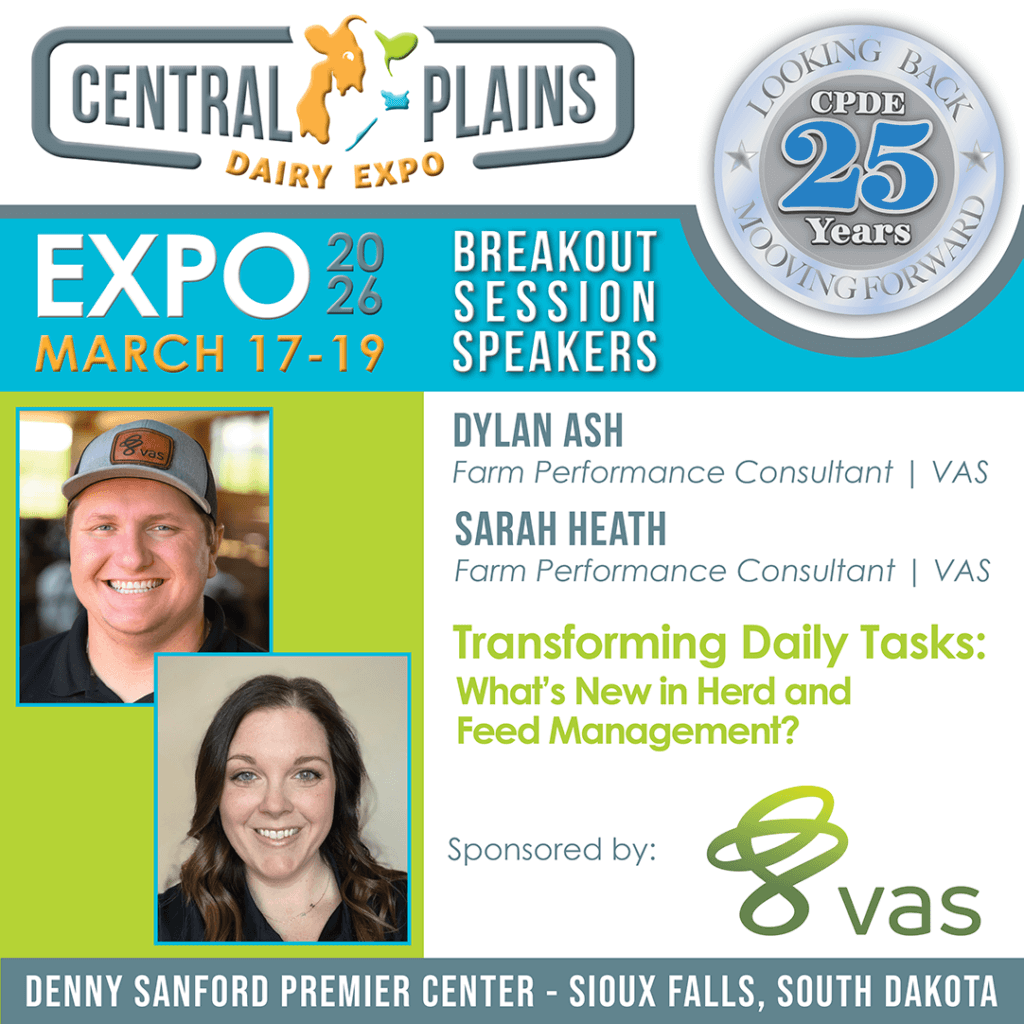
Transforming Daily Tasks: What’s New in Herd and Feed Management?
Dylan Ash
Farm Performance Consultant | VAS
Sarah Heath
Farm Performance Consultant | VAS
Smarter solutions that span your entire dairy are here. Join VAS to learn more about its newest tools, including FeedComp, an all-new feed management program. Designed to bring your entire feeding program to the palm of your hand, FeedComp’s simplicity and integrated herd and feed insights help you manage with clarity. Plus, see how new DairyComp features make daily workflows simpler, faster and more efficient.
Dylan Ash collaborates with dairy producers and industry professionals in Minnesota as a farm performance consultant for VAS. In this role, Ash helps producers enhance operational efficiency and empower them to make more informed, data-driven decisions using the VAS suite of products. He is a graduate of Dordt University where he earned a bachelor’s degree in business administration, broadening his network and expertise role within the dairy industry.
Sarah Heath is a farm performance consultant at VAS where she partners with dairy producers and industry professionals across Western and Central Wisconsin. Leveraging her extensive, hands-on experience in the dairy industry, Heath helps producers optimize performance on their dairy with VAS products and services. She holds a bachelor’s degree in animal science with a dairy emphasis from the University of Wisconsin-Platteville.

The Sweet Spot: Building Better Calves with the Right Carbohydrates
Grace Cun
Dairy Technical Nutrition Manager | Westway Feed Products
The way calves are fed in the first six months of life has a lasting impact on how well they eat, grow and perform later as cows. While calf diets are often discussed in terms of milk and starter, the role of different carbohydrates, sugars, starch and fermentable fiber in rumen development is frequently overlooked. This presentation will explain how these carbohydrate sources ferment in the developing rumen and how they influence microbial activity, volatile fatty acid production and rumen tissue growth. Special attention will be given to the role of sugars, including those commonly supplied through liquid feeds and molasses, and how they support intake, fermentation and the transition onto starter feed. Participants will gain practical insight into how carbohydrate strategy can be used to promote rumen health, feed efficiency and long-term calf performance.
Grace Cun is a dairy technical nutrition manager with Westway Feed Products, supporting dairy producers and nutritionists across the Western United States. Her work focuses on improving diet formulation, mixing and rumen energy capture to help dairies extract more value from feed resources, with an emphasis on sugars, liquid feeds and fiber digesting technologies. Cun collaborates with producers, nutritionists and researchers to design on-farm trials, analyze performance data and build practical tools that guide real-world feeding decisions. She has a strong interest in early-life nutrition and how feeding young calves influences rumen development and long-term productivity. Cun’s work bridges research and commercial dairy systems to drive measurable, profitable outcomes.

Optimizing Feed and Nitrogen Efficiency in Dairy Cattle Diets by Feeding Isoacids
Andrew LaPierre
Dairy Technical Specialist | Zinpro
Recent updates to CNCPS have created sensitivities for isoacid balances in the rumen of lactating dairy cattle. Long-standing research suggests that the supplementation of these isoacids improves microbial yield and subsequent fiber digestibility in the rumen. This talk will discuss the details of these updates, how they lead to a better prediction in dairy cattle performance and what options exist to solve potential isoacid imbalances.
Andrew LaPierre is a dairy technical specialist with Zinpro and contributes as a CNCPS consultant for Cornell University. LaPierre grew up on his family’s sixth-generation dairy farm in Chazy, N.Y., which is currently owned and operated by his parents and brother. He received his PhD at Cornell University where he studied the effects of amino acid balancing and varying energetic nutrients on dairy cattle productivity. Once completed, LaPierre took a post-doctoral position at Cornell University, working on research and development of the Cornell Net Carbohydrate and Protein System (CNCPS). His primary focus was the development of CNCPS v7 for commercial application. He is currently one of three inventors of this technology and provides support for Cornell University as it looks to roll out this update. LaPierre’s professional interests involve nutritional modeling of rumen and post-absorptive metabolism in ruminants, nutrient excretion and stochastic determination of productivity.
Bovine Respiratory Disease Calf Case Study: Initial Diagnosis and Investigating a Failed Solution
Joe Armstrong
Technical Service Veterinarian | Zoetis
The presenter will discuss a calf case study in detail. Together, attendees and the presenter will find an initial solution for the bovine respiratory disease (BRD) outbreak and then investigate a similar outbreak more than a year later after the initial solution appears to fail. Primary topics include calf BRD differential diagnosis, non-product-based solutions for BRD and product-based solutions for BRD.
Joe Armstrong is a member of the Zoetis Dairy Technical Service Team and focuses on helping dairy and beef operations with the practical application of evidence-based medicine and management. With Zoetis, he is responsible for providing technical support in Minnesota, Western Wisconsin and Northeast Iowa. Armstrong received his bachelor’s degree in biology from the University of Minnesota-Morris in 2011. He graduated from the University of Minnesota College of Veterinary Medicine in 2015. After veterinary school, Armstrong worked as a private practitioner with beef and dairy farms at Anderson Veterinary Service in Zumbrota, Minn. Then, he worked as the cattle production systems extension educator at the University of Minnesota.
Ed Shed Sessions

From Gadgets to Game-Changers: Picking the Right Tech for Your Dairy
Torie Little
Regional Commercial Lead / Bower Ag (Ag Property Solutions)
Dairy producers face more technology choices than ever, but what truly matters is finding solutions that align with your farm’s unique management style and bottom-line goals. This presentation dives into practical strategies for navigating today’s tech landscape, cutting through the noise, zeroing in on what fits and empowering producers to select tools that enhance herd care, productivity and profitability. Participants will leave with a step-by-step, real-world artificial intelligence (AI) prompt framework – built from our customer-tested approach – that they can reuse to evaluate future technology decisions on their own. The presenters will share concrete examples showing how producers applied this evaluation process to actual farm scenarios. Leave with a reusable prompt and confidence to make technology decisions that drive herd care, productivity and profitability.
With over 20 years in the dairy industry, Torie brings deep operational experience across organic and conventional systems. She spent 12 years in dairy management, overseeing large herds and teams, before transitioning to the milking equipment side of the business. Over the past seven years, she has worked closely with producers on technology integration, barn design, and long-term facility planning, with a strong emphasis on practical execution and producer outcomes.
Unlocking More Value from the Technology You Already Own
Tim Kinches
Smart Farming Dairy Specialist / Datamars Livestock
Many dairy operations invest in powerful technology but only use a fraction of its capabilities. This session explores commonly underutilized features across herd management, feed and monitoring systems, and shows how producers can improve efficiency and decision-making by better leveraging the tools they already have – without adding new technology. Learn how to identify underused herd management software features, improve feed management using existing software tools, gain more value from activity and monitoring systems, and understand how connected data platforms improve efficiency.
With more than 22 years in the feed and dairy industry, Tim Kinches brings deep experience in dairy nutrition, on-farm analytics and business consulting. In his role at Datamars, he works closely with producers to implement technology and data solutions that improve operational efficiency and support better decision-making.

Using DRMS FreshFocus and Fresh Cow Index to Monitor and Improve Your Transition Cow Management Program
Greg Palas
Manager of User Support Services / DRMS
Cassie Sawyer
Assistant Manager of User Support Services / DRMS
The transition period remains one of the most critical windows for dairy herd health and profitability. This session introduces the Fresh Cow Index (FCI), a research-backed performance metric developed by DRMS and Albert DeVries, University of Florida, using more than 3 million lactation records and 25 cow-level variables. FCI compares actual versus predicted energy-corrected milk (ECM) at first test to create a standardized benchmark for fresh cow success – enabling dairies to identify gaps in transition support, dry period management and early health outcomes. Attendees will see how this new index, delivered through the HerdHQ platform, helps producers monitor fresh cow performance and make data-informed decisions earlier in lactation.
Greg Palas has dedicated more than four decades to DRMS, where he manages the Ames, Iowa support office and contributes dairy expertise to software development and education. A graduate of Iowa State University with a bachelor’s degree in dairy science and master’s work in dairy cattle genetics, he combines deep technical knowledge with a lifelong passion for supporting dairy producers. At DRMS, Palas leads efforts to ensure producers, service affiliates and consultants have access to accurate records, innovative tools and responsive education. His career reflects DRMS’s mission of pairing trusted data with hands-on support to strengthen the dairy industry.
Agriculture has always been at the heart of Cassie Sawyer’s life. She grew up on a small dairy in Central Iowa and gained experience with larger herds during college. A proud Iowa State University graduate, she earned her bachelor’s degree in agricultural communications and dairy science, blending technical expertise with communication skills that help her connect with producers. For the past 19 years, Sawyer has been part of DRMS, where she now serves as assistant manager of user support services. In this role, she helps producers, consultants and service affiliates solve problems quickly and get the most from their data and reports.

Do More With Less: New Technology Boosts Your Existing Parlor
Anthony Loken
Sales Specialist – Milking and Cooling / GEA Farm Technologies
Labor challenges and the pressure to milk more cows aren’t new – but how you tackle them can be. This session will show you how to integrate the DairyProX system into your current parlor to streamline milking workflows, improve throughput and deliver consistent results – all with fewer people in the pit. See how the right tools and strategy can help you accomplish more with the team.
Anthony Loken is a sales specialist – milking and cooling with GEA, bringing more than eight years of experience with the company and five years at the dealership level in sales and support. His expertise is grounded in a lifetime of dairy work, including 15 years milking cows and 18 years of farm labor from childhood, where he learned the realities of throwing bales, pitching calf pens and working long hours in the barn. With this deep practical background, Loken offers a unique perspective on bridging traditional dairy practices with modern innovations, helping producers understand and adopt semi-automated robotic milking solutions that improve efficiency while honoring the heritage of farming.

Building Your Integrated Pest Management Program for Fly Control
Anna Hansen
Technical Services Support Specialist / MGK
On farms, fly control is easy to push down the list of priorities until fly populations explode, leading to costly impacts, such as pinkeye, reduced milk production and reduced weight gain. This session will overview flies most common in dairy facilities and provide guidance for building an effective integrated pest management (IPM) program, including nonchemical control methods and how to balance insecticides effectively. As insecticide resistance continues to rise, we will also review how to select the right formulations and modes of action (MoA), and how to rotate products to maintain long-term control.
Anna Hansen is a technical service support specialist at MGK, where she provides support internally at MGK and externally to customers, and is also responsible for new product label writing. She completed her bachelor’s degree in biology and German at Concordia College in Moorhead, Minn., and received her master’s degree in entomology at the University of Minnesota. Her graduate research focused on biting fly management on organic dairy farms. After graduating, she worked in the pest control industry as a technician and quality assurance/field training coordinator.
Silage Management and Practices
James Weideman
Owner / Midwest Sidewalls
This presentation will cover best practices for effective silage management to help improve feed quality, reduce spoilage and increase on-farm efficiency. Key topics include proper packing techniques, tire coverage and sealing methods to protect silage from air and moisture. Attendees will also learn about plastic options, the role of silage inoculants and correct feed-out practices. The session concludes with important safety considerations when working around silage piles to help protect farm workers and equipment.
James Weideman is the owner of Midwest Sidewalls, a company dedicated to helping agricultural producers operate more efficiently through innovative equipment solutions. Midwest Sidewalls specializes in sidewalls, plastic, silage attachments and other agricultural products designed to improve performance, reduce waste and streamline daily operations. With hands-on experience in the agricultural industry, Weideman brings practical knowledge and real-world insight to his presentations. His focus is on helping farmers and agribusinesses adopt tools and strategies that increase efficiency, reliability and long-term success. As a speaker, Weideman is known for his straightforward approach, industry expertise and commitment to supporting the evolving needs of today’s agricultural operations.
Not All Probiotics are Created Equal: Novonesis’ Farm-proven Strains that Work Harder for Your Herd
Ryan Royer
Technical Services Manager/DVM | Novonesis (formerly ChrHansen)
The probiotic market for dairy farms is vast and can be confusing to understand. This talk will help describe why Novonesis’ probiotics are unique, thoroughly studied and backed by research. This presentation will present general data on differences among probiotics, prebiotics and postbiotics, and what each can and cannot provide to the dairy cow, followed by research that makes Novonesis’ probiotics unique. The session will conclude with understanding probiotic labeling when producers evaluate different probiotic products.
Ryan L. Royer, DVM, has served as a technical services manager for Novonesis (formerly ChrHansen) since June 2024. In this role, Royer leverages his 22 years of veterinary practice and on-farm experience in both veterinary practice and nutrition consulting to support a broad customer base. He focuses on integrating the health and performance benefits of livestock probiotics and silage inoculants into dairy operations. Known for his practical, solutions-oriented approach, he consistently prioritizes animal health and welfare. In the field, Royer collaborates closely with the sales team to address real-world challenges faced by dairy producers, including the review of forage nutrient and fermentation analyses and the investigation of gut health, and overall health and performance in dairy cows and calves. Additionally, in partnership with university and contract researchers, he works with the technical services team to design, conduct and communicate relevant, scientifically robust research. These efforts aim to answer the practical questions commonly faced by dairy and beef producers and contribute to the growing body of knowledge surrounding the unique biosolution technologies within the vast Novonesis portfolio.
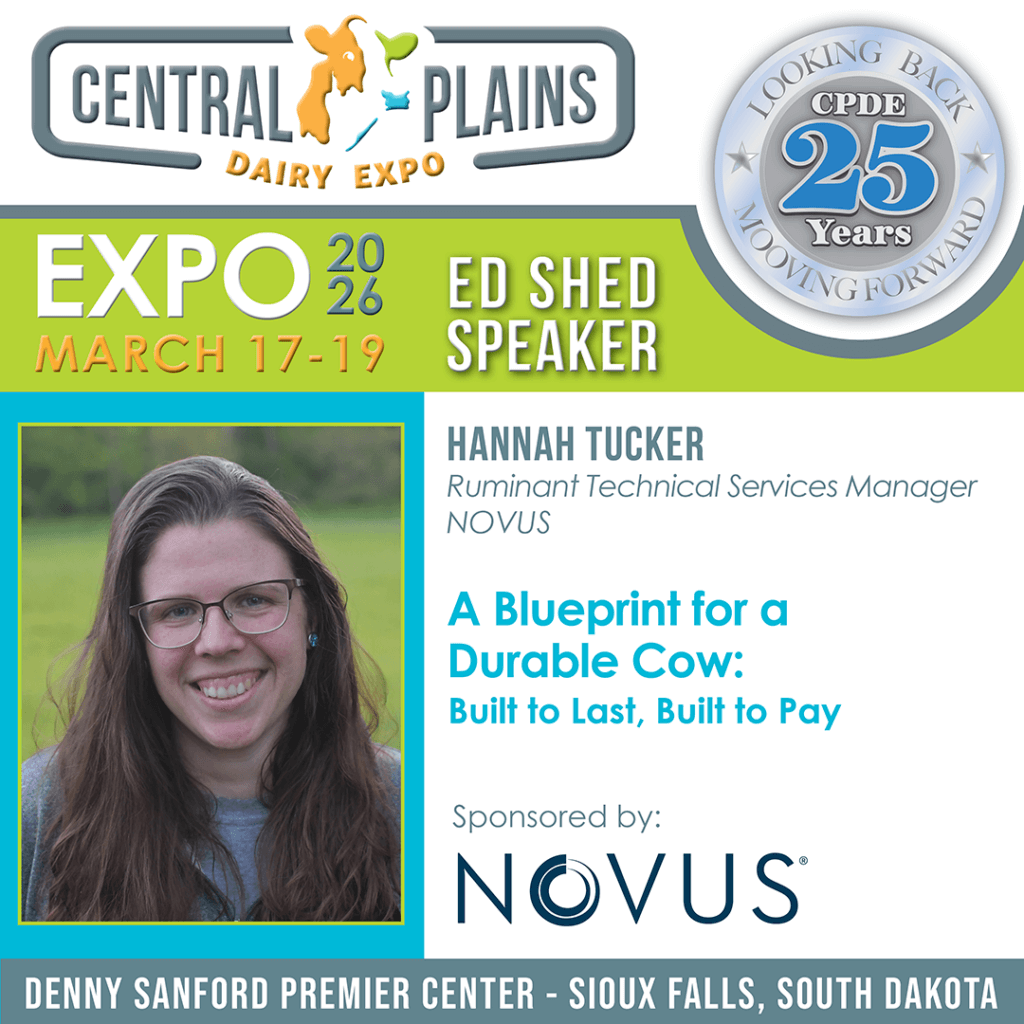
A Blueprint for a Durable Cow: Built to Last, Built to Pay
Hannah Tucker
Ruminant Technical Services Manager / NOVUS
Are your best cows falling short? It’s not always the big problems you see coming but the multiple minimal and persistent ones that eat away at performance. Sore feet, delayed heats and cows that just don’t bounce back after freshening can all point to the same issue: they’re not getting what they need from the ration, even when it looks right on paper. In this practical session, Tucker will talk through what these problems look like in the barn. She’ll walk you through how to support the three pillars of a productive herd: raising strong heifers, smooth transitions and getting cows bred back on time. If you’ve ever wondered why your cows aren’t reaching their potential or why some just don’t last when everything seems in place, this session is for you.
Hannah Tucker was raised in the dairy industry and now works with the NOVUS Sales Team in North America to determine the best way to support customer goals and address production challenges. She also collaborates with the NOVUS Research and Development Team to design university and field trials, and translate the results to further understand the nutrition company’s solutions. Before joining NOVUS, Tucker served as a ruminant nutritionist with Sioux Nation Ag where she formulated rations, provided ingredient insights to the feed mill and helped troubleshoot challenges on its farms. She earned her bachelor’s degree in animal science at Michigan State University and master’s degree in dairy science and doctorate in animal science at Virginia Polytechnic Institute and State University.
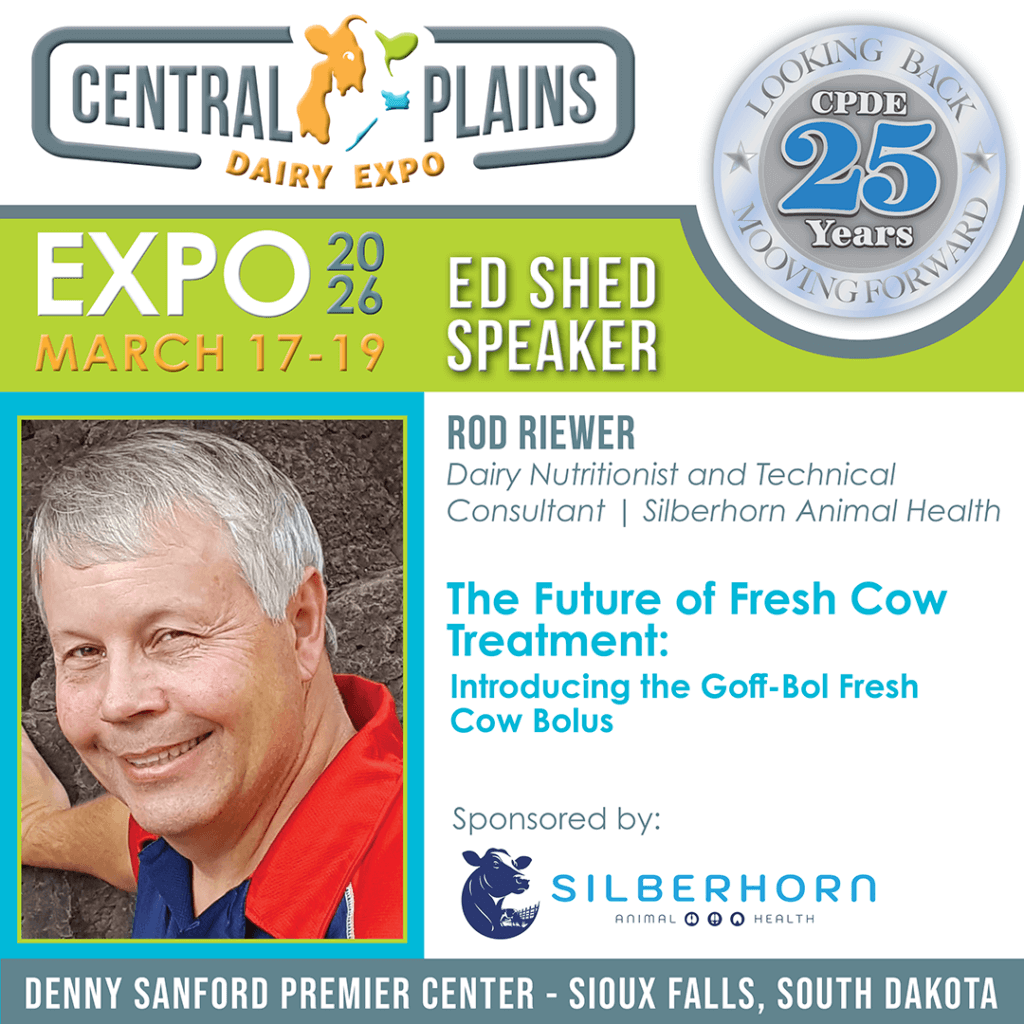
The Future of Fresh Cow Treatment: Introducing the Goff-Bol Fresh Cow Bolus
Rod Riewer
Dairy Nutritionist and Technical Consultant / Silberhorn Animal Health
Getting fresh cows off to a productive and healthy start will always be a high priority. In this session, we will present a new, innovative bolus treatment for fresh cows, the Goff-Bol Solanum bolus. The objective of this session is to inform producers about how to use this new product to their advantage, what is unique about it and how it can help cows be more productive with fewer negative health events.
Rod Riewer is a graduate of the University of Minnesota College of Veterinary Medicine. After graduation, he spent 13 years as a veterinary practitioner in Minnesota and South Dakota. Riewer has also worked as a dairy nutritionist and technical support veterinarian in the feed industry. Currently, Riewer works as a dairy nutritionist and technical consultant for Silberhorn Animal Health and Feedworks USA.
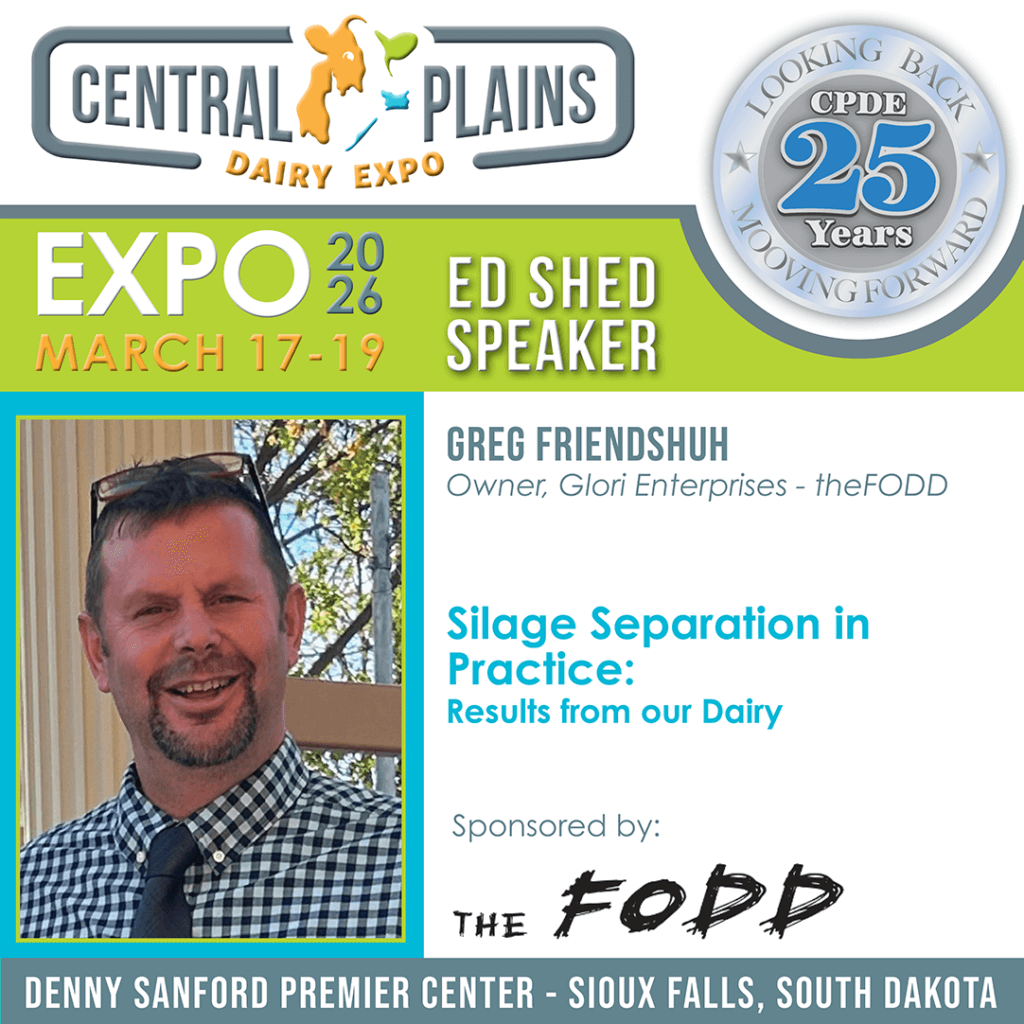
Silage Separation in Practice: Results from our Dairy
Greg Friendshuh
Owner | Glori Enterprises – theFODD
This presentation shares our on-farm experience with silage separation, including how the idea and machine evolved, how the system works today, and how it fits into our overall feeding program. We’ll discuss the practical results we’ve seen on our dairy, including impacts on feed costs, production, ration flexibility, cow behavior, and feed efficiency.
Greg Friendshuh is a dairy producer and agricultural innovator specializing in feed efficiency, operational consistency, and cost reduction. He brings hands-on leadership, real-farm experience, and a farmer-driven approach to improving dairy performance and long-term sustainability.

Electrically Clean Dairies: Understanding and Eliminating Stray Voltage
James Neawedde
Director of Operations / Zero Tolerance LLC
Stray voltage quietly drains dairy performance by disrupting cow behavior, lowering feed efficiency and reducing milk output – costs most farms never see coming. This session explains how electrical noise forms, how to identify it and what practical steps can be taken to correct it. Attendees will learn how improvements in grounding, power quality and equipment selection can reduce operational losses and unlock measurable returns in production, herd health and equipment reliability. This session has evolved from: “This is a problem you don’t understand” to “This is a solvable engineering standard – and we built it.”
James (Jim) Neawedde is the director of operations at Zero Tolerance/Current Defense and co-developer of a patent-pending process for stray voltage mitigation and electrical certification. With more than 20 years of experience in advanced manufacturing and power systems – including leadership roles at ABB, Panduit and Rockwell Automation – he focuses on eliminating electrical noise sources that impact cow comfort, productivity and equipment reliability.
Spanish Sessions

Why is Beef on Dairy the New Buzz?
¿Por qué los cruces de carne y leche están en auge?
Jorge Delgado
Dairy Production Specialist | Alltech
Sebastian Mejia Turcios
On-Farm Sustainability Specialist | Alltech
Employees will understand why beef and dairy crosses are increasing in the dairy industry. Many dairy employees do not understand why this market is increasing and why they see more and more beef-dairy crosses in their operations. Employees will also understand market changes, demand for beef, beef channels and how their involvement is so important in this new buzz, as they are not well informed due to lack of communication.
Los empleados entenderán por qué los cruces entre carne y leche están aumentando en la industria lechera. Muchos empleados de la industria lechera no entienden por qué este mercado está creciendo ni por qué ven cada vez ven más cruces de carne y leche en sus operaciones. Los empleados también comprenderán los cambios en el mercado, la demanda de carne de vacuno, los canales de carne de vacuno y lo importante que es su función en este nuevo auge, ya que no están bien informados debido a la falta de comunicación.
Jorge Delgado belongs to a family of dairy farmers and he is originally from Ecuador, South America. He received his bachelor’s degree in agriculture and dairy science from EARTH University in Costa Rica. Then, he returned to Ecuador where he worked in the dairy industry, representing a genetics company doing consulting, sales and training until moving to the United States in 2002. Next, Delgado worked on multiple dairy farms as a herd manager for 10 years and joined Alltech as a dairy specialist in 2010 as part of the Alltech On Farm Program. In 2014, he joined Elanco to lead the Dairy Training Program and focused on empowering dairy workers. Four years later, Delgado returned to Alltech and created the Alltech People + program (training, talent development and retention program for dairy workers), providing his expertise to help dairy producers with people management practices, herd health, milk quality, calf management and customized protocols.
Jorge obtuvo su licenciatura en Agricultura y Ciencias Lecheras en la Universidad EARTH en Costa Rica, y luego regresó a Ecuador, donde trabajó en la industria lechera representando a una empresa genética realizando consultoría, ventas y capacitación hasta mudarse a los Estados Unidos en el 2002. Delgado trabajó después en varias granjas lecheras como administrador durante 10 años y se incorporó a Alltech como especialista en lecherías en el 2010 como parte del programa Alltech On Farm. En el 2014, Delgado se trasladó a Elanco para liderar el Programa de Capacitacion en Lecherías, centrado en empoderar a los trabajadores de la industria lechera. En el 2018, Delgado regresó a Alltech y ayudo a crear el programa Alltech People + (programa de formación, desarrollo de talento y retención para trabajadores de las lecherías), aportando su experiencia para ayudar a los productores lecheros con prácticas de manejo del personal, salud del hato, calidad de la leche, manejo de terneros y la creación de protocolos personalizados.
Sebastian Mejia Turcios was born and raised in Honduras, where his early exposure to agriculture sparked a lifelong interest in livestock production. He earned a bachelor’s degree in agronomy from EARTH University in Costa Rica and a master’s degree in animal science from Texas Tech University. In June 2024, he completed his PhD in animal biology at the University of California-Davis. Mejia Turcios is passionate about translating science into practical, on-farm solutions and engaging directly with producers and industry stakeholders. His work focuses on advancing sustainable livestock systems through collaboration, education and applied research. Currently, Mejia Turcios works closely with producers, supply-chain partners and industry leaders to develop and implement sustainability projects that create tangible value at the farm level. His role supports Alltech’s purpose of Working Together for a Planet of Plenty.
Sebastian Mejia Turcios nació y creció en Honduras, donde su contacto temprano con la agricultura despertó un interés duradero por la producción pecuaria. Obtuvo una licenciatura en agronomía en la Universidad EARTH en Costa Rica y una maestría en ciencia animal en Texas Tech University. En junio de 2024, completó su doctorado en biología animal en la Universidad de California, Davis. Mejia Turcios es un firme defensor de la aplicación práctica del conocimiento científico y del trabajo cercano con productores y actores clave de la industria. Su labor se enfoca en impulsar sistemas ganaderos más sostenibles a través de la colaboración, la educación y la investigación aplicada. Actualmente, se desempeña donde trabaja de manera cercana con productores, socios de la cadena de suministro y líderes del sector para desarrollar e implementar proyectos de sostenibilidad que generen valor tangible a nivel de finca. desarrollar e implementar proyectos de sostenibilidad que generen valor tangible a nivel de finca. Su trabajo está alineado con el propósito de Alltech de “Trabajar juntos por un Planeta de Abundancia.”
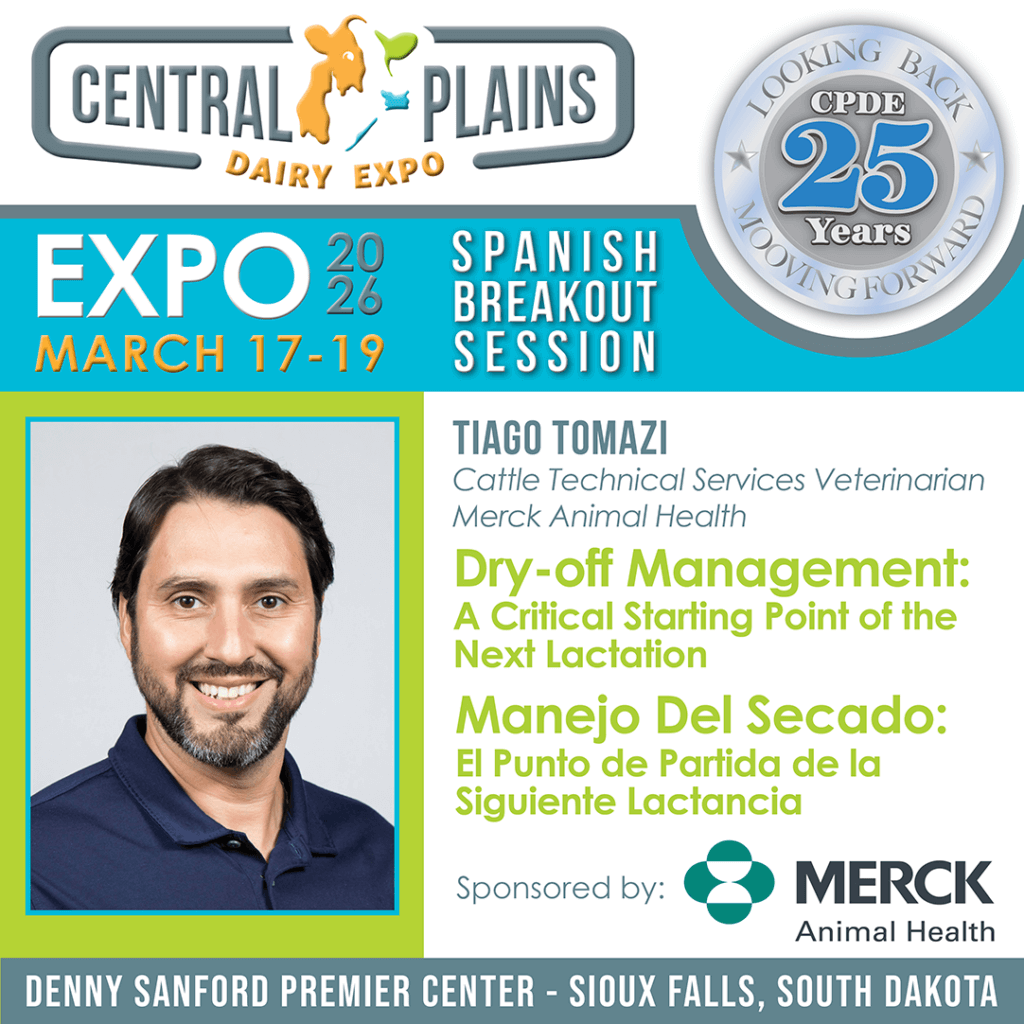
Dry-off Management: A Critical Starting Point of the Next Lactation
Manejo Del Secado: El Punto de Partida de la Siguiente Lactancia
Tiago Tomazi
Cattle Technical Services Veterinarian | Merck Animal Health
The dry period is more than a break from lactation – it’s a pivotal phase that influences udder health and future milk production. This program will explore the science and practical strategies behind effective dry-off protocols, mastitis prevention and the role of tools like teat sealants, targeted antibiotics and 24/7 monitoring during the dry and transition periods. Learn how to safeguard cow health, prevent new infections and build a foundation for peak productivity in the next lactation.
El período seco es mucho más que una pausa en la lactancia: es una fase clave que influye en la salud de la ubre y en la producción futura de leche. Esta charla explorará la base científica y las estrategias prácticas detrás de protocolos efectivos de secado, la prevención de mastitis y el papel de herramientas como los selladores de pezones, el uso dirigido de antibióticos y el monitoreo 24/7 durante el período seco y de transición. Aprenda cómo proteger la salud de las vacas, prevenir nuevas infecciones intramamarias y sentar las bases para lograr una productividad máxima en la siguiente lactancia.
Tiago Tomazi is a veterinarian specializing in dairy cattle health. He earned a master’s degree in veterinary sciences from the University of São Paulo (Brazil) and conducted doctoral research in mastitis epidemiology at Cornell University’s Quality Milk Production Services. He subsequently served as a postdoctoral associate at Cornell before joining Merck Animal Health’s Technical Services team in 2021. His expertise centers on the epidemiology and control of infectious diseases in dairy cattle, with a strong focus on improving herd health, food safety and milk quality.
Tiago Tomazi es un médico veterinario especializado en la salud del ganado lechero. Obtuvo su maestría en Ciencias Veterinarias en la Universidad de São Paulo (Brasil) y realizó su investigación doctoral en epidemiología de mastitis en Quality Milk Production Services de la Universidad de Cornell (EE. UU.). Posteriormente, se desempeñó como investigador en la misma universidad antes de incorporarse al equipo de Servicios Técnicos de Merck Animal Health en 2021. Su experiencia se centra en la epidemiología y el control de enfermedades infecciosas en ganado lechero, con un fuerte enfoque en la mejora de la salud del hato, la inocuidad alimentaria y la calidad de la leche.

Closing the Door on Germs: Safe Handling of Every Injury
Prevention of Zoonosis Risks Through Consistent Wound Management
Cerrando la Puerta a los Gérmenes: Manejo Seguro de Cada Lesión
Prevención de Riesgos de Zoonosis Mediante el Manejo Consistente de Heridas
Maristela Rovai
Associate Professor/Extension Dairy Specialist | South Dakota State University
Noelia Silva del Rio
Dairy Herd Health Specialist | University of California-Davis School of Veterinary Medicine
We want a strong and healthy team. This session is dedicated to understanding a key farm risk: zoonoses transmitted through contact with animal injuries. We will discuss why an untreated animal wound can become a gateway for diseases that affect us all, including rare but serious infections, such as screwworm myiasis. The presenters will cover the three pillars of effective biosecurity: 1) Early recognition of dangerous wounds, 2) Simple PPE (personal protective equipment) protocols for injury management, and 3) Hygiene routines that protect us from the barn to home.
Queremos un equipo fuerte y sano. Esta sesión está dedicada a comprender un riesgo clave en la granja: las zoonosis que se transmiten al tener contacto con heridas de animales o al lastimarnos al trabajar con ellos. Discutiremos por qué una herida sin atender – ya sea una cortada en nuestra mano o una lesión en un animal que estamos tratando – puede ser una puerta de entrada para enfermedades que nos afectan a todos, incluidas las infecciones graves. Cubriremos los tres pilares para una bioseguridad efectiva: 1) Reconocimiento temprano de heridas peligrosas, 2) Protocolos sencillos de EPP (Equipo de Protección Personal) para el manejo de lesiones, y 3) Rutinas de higiene que nos protegen del corral al hogar.
Maristela Rovai is an associate professor and extension dairy specialist in the department of dairy and food science at South Dakota State University (SDSU) in Brookings, S.D. Rovai studied veterinary medicine in Brazil and completed her master’s and doctoral degrees at the Universitat Autònoma de Barcelona (UAB) in Spain. She pursued postdoctoral research in the United States, at the University of Wisconsin-Madison and the E. (Kika) de la Garza American Institute at Langston University, and in Europe at the Technical University of Munich and UAB-Spain, focusing on mammary gland physiology and ruminant management. Rovai develops SDSU Extension programs to improve milk quality, assists dairy producers in training Hispanic employees and develops training programs specifically for Hispanic employees. Her academic and research interests are dairy extension, milk quality, mastitis and workforce training.
Maristela Rovai es profesora asociada y especialista en extensión lechera en el departamento de ciencia láctea y alimentaria de la Universidad Estatal de Dakota del Sur (SDSU) en Brookings, Dakota del Sur. Rovai estudió medicina veterinaria en Brasil y completó sus estudios de maestría y doctorado en la Universitat Autònoma de Barcelona (UAB) en España. Realizó investigaciones posdoctorales en Estados Unidos, en la Universidad de Wisconsin-Madison y en el Instituto Americano E. (Kika) de la Garza en la Universidad de Langston, y en Europa, en la Universidad Técnica de Múnich y en la UAB-España, centrándose en la fisiología de la glándula mamaria y el manejo de rumiantes. Rovai desarrolla programas de extensión de SDSU para mejorar la calidad de la leche, brinda capacitación a productores lecheros para la formación de empleados hispanos y desarrolla programas de capacitación específicos para este grupo. Sus intereses académicos y de investigación se centran en la extensión lechera, la calidad de la leche, la mastitis y la capacitación de la fuerza laboral.
Noelia Silva del Rio has served as the dairy herd health specialist at the University of California-Davis School of Veterinary Medicine since 2012. Previously, she was the dairy advisor in Tulare County (California) for three years. She is located at the Veterinary Teaching and Research Center, a satellite unit of the veterinary school in Tulare County. She obtained her Doctor of Veterinary Medicine degree from Spain and her PhD in dairy nutrition and reproductive physiology from the University of Wisconsin-Madison. Her research interests encompass transition cow and calf health, dairy herd sustainability and animal welfare. Additionally, she is deeply interested in improving dairy worker performance and developing tools to motivate positive changes in dairy operations.
Noelia Silva del Rio trabaja como especialista en salud del ganado lechero en la Facultad de Medicina Veterinaria de la Universidad de California-Davis desde 2012. Anteriormente, fue asesora de ganadería lechera en el condado de Tulare (California) durante tres años. Su lugar de trabajo se encuentra en el Centro de Enseñanza e Investigación Veterinaria, una unidad satélite de la facultad de veterinaria en el condado de Tulare. Obtuvo su título de Doctora en Medicina Veterinaria en España y su doctorado en nutrición y fisiología reproductiva del ganado lechero en la Universidad de Wisconsin-Madison. Sus áreas de investigación incluyen la salud de las vacas en transición y los terneros, la sostenibilidad de las explotaciones lecheras y el bienestar animal. Además, tiene un gran interés en mejorar el desempeño de los trabajadores del sector lácteo y en desarrollar herramientas para impulsar cambios positivos en las operaciones ganaderas.

The 21-Day Window: Maximizing Profitability in the Transition Period
La Ventana de los 21 Días: Maximizando la Rentabilidad en el Período de Transición
María Oconitrillo
Bilingual Dairy Management Advisor | smaXtec
What if you could see what’s happening inside the cow before and after freshening? The transition period is a critical window where small changes can drive long-term outcomes. What occurs in the days before and after calving often sets the trajectory for the entire lactation, yet early warning signs for potential issues are often missed. In this session, the presenter will take a closer look at the 21-day transition window to show how continuous internal cow monitoring brings hidden health challenges to the surface sooner and replaces guesswork with clarity. Learn how early detection and faster decision-making can protect cow health and uncover hidden profit potential.
¿Qué pasaría si pudiera ver lo que sucede dentro de la vaca antes y después del parto? El período de transición es una ventana crítica en la que pequeños cambios pueden generar impactos a largo plazo. Lo que ocurre en los días previos y posteriores al parto suele marcar el rumbo de toda la lactancia; sin embargo, muchas veces se pasan por alto las señales tempranas de posibles problemas. En esta sesión, María analizará en profundidad la ventana de transición de 21 días para mostrar cómo el monitoreo interno continuo de la vaca permite detectar antes desafíos de salud que normalmente permanecen ocultos y reemplaza las suposiciones por información clara. Aprenda cómo la detección temprana y una toma de decisiones más rápida pueden proteger la salud de las vacas y revelar un potencial de rentabilidad oculto.
Originally from Costa Rica, María Oconitrillo brings an agronomy and animal nutrition background to her work in the dairy industry. She earned her master’s degree in animal nutrition from Iowa State University and has professional experience working as an animal nutritionist throughout the United States. At smaXtec, Oconitrillo leads the bilingual support, helping dairy farms integrate technology while training and supporting English- and Spanish-speaking farm workers to improve communication, adoption and day-to-day success on dairy operations.
Originaria de Costa Rica, María Oconitrillo aporta a la industria lechera con una formación sólida en agronomía y nutrición animal. Obtuvo su maestría de nutrición animal en Iowa State University y cuenta con experiencia profesional trabajando como nutricionista animal en distintos estados de EE.UU. En smaXtec, Oconitrillo lidera el soporte bilingüe, ayudando a las lecherías a integrar tecnología mientras capacita y brinda apoyo a los trabajadores de campo en inglés y español, con el objetivo de mejorar la comunicación, la adopción de la tecnología y el éxito diario de las grajas lecheras.

Producing Quality Milk is a Daily Challenge
Producir Leche de Calidad es un Reto Diario
Bernard Kwaku
Dairy Production Specialist | Zoetis
This presentation is multi-factorial and covers basic day-to-day steps needed to harvest quality milk, things to look out for and ways to mitigate challenges.
Esta presentación abarca múltiples factores y trata sobre los pasos básicos que se deben seguir a diario para obtener leche de calidad, los aspectos a tener en cuenta y las formas de mitigar los problemas que puedan surgir.
Bernard Kwaku grew up in the capital city of Ghana, Africa. He arrived in the United States through the U.S. Holstein Association trainee program in 1989 from Denmark. Since then, he has worked in all facets of the dairy industry – starting as a cow pusher to becoming a dairy manager. In 2009, Kwaku joined the corporate world by working as a quality milk manager for Pfizer Animal Health, which became Zoetis. In his current role as a dairy production specialist, Kwaku shares his knowledge with dairy employees. Additionally, he supports dairy producers by providing them with value-added services, such as employee training and problem solving through a holistic and systematic approach.
Bernard Kwaku creció en la capital de Ghana, África. Llegó a Estados Unidos en 1989 procedente de Dinamarca, a través del programa de formación de la Asociación Holstein de Estados Unidos. Desde entonces, ha trabajado en todos los ámbitos de la industria láctea, comenzando como operario en una granja y llegando a ser gerente de una explotación lechera. En 2009, Kwaku se incorporó al mundo corporativo trabajando como gerente de calidad de leche para Pfizer Animal Health, empresa que posteriormente se convirtió en Zoetis. En su puesto actual como especialista en producción lechera, Kwaku comparte sus conocimientos con los empleados del sector. Además, apoya a los productores de leche brindándoles servicios de valor añadido, como formación para el personal y resolución de problemas mediante un enfoque integral y sistemático.